
Understanding Israel from Scripture, Part Four
Israel and the Apocalyptic Book of Daniel

I introduced Part Three of this series with a simple definition in my own words of what dispensationalism is. So as not to be accused of arguing from the logical fallacy of generalization, here is a definition from Dr. Paul Enns:
DISPENSATIONALISM IS A SYSTEM of interpretation that seeks to establish a unity in the Scriptures through its central focus on the grace of God. Although dispensationalists recognize differing stewardships or dispensations whereby man put under a trust by the Lord, they teach that response to God’s revelation in each dispensation is by faith (salvation is always by grace through faith). Dispensationalists arrive at their system of interpretation through two primary principles: (1) maintaining a consistently literal method of interpretation, and (2) maintaining a distinction between Israel and the church.[1]
My current copy of The Moody Handbook of Theology, from which the above quote was taken, had the forward written by Dr. John F. MacArthur, Jr. Therefore, I may confidently presume that this definition of dispensationalism was alright with the late Dr. MacArthur. I had an earlier edition of The Moody Handbook of Theology, from 1989 (which I believe I left on the mission field); and if I haven’t misremembered, I think Dr. MacArthur wrote the forward to that edition as well.
Concerning this definition, it contains in it the primary reason why the dispensational hermeneutic is different from a Christ-centered hermeneutic. Attempting to establish unity in the Scriptures through a central focus on the grace of God presents the root of the problem. While I wholeheartedly agree that God’s grace runs throughout the entirety of Scripture,[2] it is not the central truth that provides that unity. The Lord Jesus Himself provides that unity, as it is written:
And He is before all things, and in Him all things hold together. Colossians 1:17
The central focus of life upon earth is the same central focus of eternal life for all eternity, the Lord Jesus Christ. To promote any of God’s graces, blessings, or promises to be of equal or greater priority or preeminence to the Lord Jesus Messiah perverts the gospel and diminishes the glory of God through Christ alone.
We ended the last part of our series with a Scripture portion from the second chapter of Daniel. In this fourth part of the series, we will examine briefly, and not exhaustively, a Christ-centered interpretation of this historical, prophetic, and apocalyptic book of the Old Testament. In other words, in our Christo-centric view and understanding of the book, I desire to present a partial preterist interpretation of the book overall, as well as highlighting some key passages from its chapters; keeping in mind what we read last time in Part Three, that the Lord Jesus Christ is at least the partial fulfillment of these prophetic passages, as well as the ultimate fulfillment of those Scriptures in some way, shape, or form.
A CHRISTO-CENTRIC OVERVIEW OF DANIEL
Daniel is a book that exalts Jesus Christ throughout, not as an adornment that beautifies an emphasis elsewhere, but the very central theme of the writing. In the practical this writing highlights faithfulness and prayer. Both are exalted characteristics of our Lord’s ministry. Jesus was the faithful Prophet in the midst of unbelief and opposition. Moreover, the Lord Jesus, as perfect and sinless Man, He was certainly a Man of prayer. He prayed early in the morning (Mark 1:35a). He found places of solitude to pray (Mark 1:35b). He taught others to pray (Matt 6:9-13; Luke 11:1-13; John 14:13-14). He prayed at gravesides (John 11:41-42). He prayed before meals (Matt 14:19; 26:26). He prayed all night before selecting His disciples (Luke 6:12-16). He prayed in the garden on the night He was betrayed (Matt 26:36-46; Mark 14:32-42; Luke 22:39-46; John 17:1-26). He prayed on our behalf so that His righteous, unflagging prayer life would be imputed to us because our prayers are weak and filled with selfish corruptions (Rom 8:26; Heb 7:25).
A Brief Overview of the Book of Daniel
Daniel 1 presents young Daniel and his friends as types of the Lord Jesus Christ, faithful to YHVH God in the midst of foreign rulers and dignitaries, just as Jesus came in the fullness of the time, when foreign rulers from Rome controlled Judea and Jerusalem. Daniel, Hannaniah, Mishael, and Azariah were uncompromising in the observance of the Law of Moses when it came to their dietary regimen. Jesus was the only Jew who ever kept the Law of Moses actively, passively, and completely in thought, word, and deed. Jesus said,
“Do not think that I have come to abolish the Law or the Prophets; I have not come to abolish them but to fulfill them. For truly, I say to you, until heaven and earth pass away, not an iota, not a dot, will pass from the Law until all is accomplished. Therefore whoever relaxes one of the least of these commandments and teaches others to do the same will be called least in the kingdom of heaven, but whoever does them and teaches them will be called great in the kingdom of heaven. For I tell you, unless your righteousness exceeds that of the scribes and Pharisees, you will never enter the kingdom of heaven.” Matthew 5:17-20
The only one who is great in the kingdom of heaven is the Lord Jesus. His righteousness not only exceeds the external righteousness of the scribes and Pharisees, His righteousness far exceeds that of every human who walked the face of this planet. So faithful was Jesus to fulfill the Law and please His Father that His righteousness is placed upon the account of all His redeemed, including Daniel.
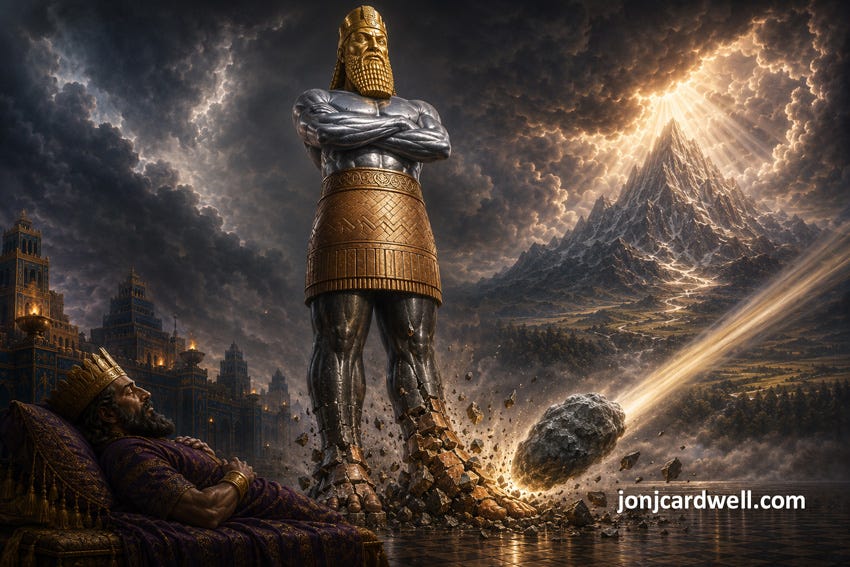
Daniel 2 presents the Stone, Jesus Messiah, striking at the feet of the idolatrous human governments in all their forms, whether gold, silver, bronze, iron, or even clay. Jesus the Stone is the emphasis of Nebuchadnezzar’s dream, not the idol made of precious metals.
Daniel 3 presents the gospel salvation that is found in the Lord Jesus Christ alone. When we are faced with the golden image of worldly idolatry and suffer the fiery indignation of those who exalt themselves above God’s Messiah, it is Jesus who is the fourth Man in the fiery furnace with us.
Daniel 4 presents the truth of Christ’s gospel and its ability to save even the most wicked, idolatrous, and self-exalting of souls. It may take seven years, or even longer. It may even drive a soul to the brink of madness, but if the Lord Jesus has a soul in His sights to save, he or she will eventually “praise and extol and honor the King of heaven” (Dan 4:37).
Daniel 5 presents the desecration of Christ by worldly men, such as Belshazzar. Everything in the tabernacle in the wilderness, and the subsequent temple built by Solomon foreshadowed the gospel of the Lord Jesus Christ. The table of the bread of presence, or shewbread (KJV), was a type of Christ because Jesus is the Bread of Life (John 6:35). The light from the golden menorah was a type of Christ since Jesus is the Light of the world (John 8:12). The altar of incense was a type of Christ for Jesus ever lives to make intercession for those He is saving (Heb 7:25). The vessels of gold, silver, and bronze were types of Christ, as gold represents Christ’s deity, silver represents Christ’s redemption, and bronze represents Christ’s judgment. These temple vessels did Belshazzar and his guests drink wine from, praising the false gods of gold, silver, bronze, stone, and wood in their drunkenness. By the writing on the wall by the hand of Christ, Belshazzar was judged and found lacking; yet when compared to the sinless, perfect, holy, and righteous Man, Christ Jesus, every man is lacking.
Daniel 6 presents Daniel once again as a type of Christ, unwavering in his allegiance to God and given to prayer. When sentenced to death by a reluctant Gentile king, it foreshadowed Pontius Pilate reluctantly sentencing Jesus to be crucified (Luke 23:20). While the lions could not touch Daniel when he was in their den, Satan, who “prowls around like a roaring lion, seeking someone to devour (1 Pet 5:8), foreshadowed Christ’s victory at the cross over the devil, crushing Satan’s head while the act bruised His heel (Gen 3:15).
Daniel 7 presents some similar, yet different, prophetic history paralleling the second chapter. Yet its main emphasis should be upon the Messiah, the Son of Man, coming in the clouds of heaven, appearing before the Ancient of Days, and receiving a kingdom that shall not be destroyed.
Daniel 8 presents a prophetic vision of the Medo-Persian and Greek empires that Daniel had difficulty understanding. The angel Gabriel appears before Daniel and gives the prophet the interpretation of the vision. The vision itself speaks of Christ, as the Messiah would speak in parables and dark sayings (Psa 78:2-3; Mark 4:33). When Gabriel appears to Daniel, he is a type of Christ, as Daniel falls down before Gabriel, and the angel touches the prophet to make him stand up (Rev 1:17). Moreover, Gabriel, as a type of Christ, explains the vision to Daniel (Mark 4:34; Luke 24:27; 2 Pet 1:20; Rev 19:10).
Daniel 9, in its first part, presents Daniel as a type of Christ, praying for his people. Jesus was the ultimate prayer warrior, as explained earlier. In the last part, Gabriel once again appears before Daniel, answering his prayer with the ultimate Messianic promise, which we will cover in a bit more detail later.
Daniel 10-12 presents a Christophany, a pre-incarnate appearance of the Lord Jesus Messiah Himself, revealing to Daniel prophetic details that would transpire in the world to establish two things: (1) confirm Daniel as a true prophet of YHVH God (Deut 18:21-22); and (2), reveal the details of the Greek Empire that would set forth the Greek culture as the predominant ethos in the time of Christ’s ministry. Alexander decreed that Greek would be the spoken and written language throughout the empire, which is why the New Testament was written in Greek.[3]
Types of Christ
Because I mentioned that Daniel was a “type of Christ” in my overviews of Daniel chapters one, six, and nine, and that the implements of the temple were types of Christ in Daniel chapter five, it seems appropriate to briefly discuss typology here. So, what is typology? I would define it in this way:
Typology in theology and biblical hermeneutics is the study of how God uses persons, events, institutions, objects, or patterns in redemptive history to foreshadow and correspond to fuller realities, especially realities fulfilled in Christ and His gospel.
Typology comes from the Greek word τύπος (TOO-pos), which is often translated “example” (ESV) or “ensample” (KJV) in verses like 1 Corinthians 10:6, 11; Philippians 3:17; 1 Thessalonians 1:7; 2 Thessalonians 3:9; 1 Timothy 4:12; Titus 2:7; 1 Peter 5:3. It has also been translated “fashion,” “figure,” “form,” “manner,” “pattern,” and “print” in other New Testament passages of Scripture.
Typology should not to be confused with “allegory,” which assigns hidden or symbolic meanings to biblical details. Allegory comes from the Greek word ἀλληγορέω (al-lā-gor-EE-ō), and is used one time in the New Testament:
Now this may be interpreted allegorically: these women are two covenants. One is from Mount Sinai, bearing children for slavery; she is Hagar. Galatians 4:24
While this Greek word is only used once in Scripture, it doesn’t mean that the only allegory in the Scripture is found in Galatians 4:24. The Book of Revelation is set in signs (Rev 1:1),[4] whereas much of the writing from that apocalyptic book is given in symbolic imagery.
The Old Testament also corroborates the use of allegory, as YHVH God speaks through Hosea, a prophet who was a contemporary with Isaiah:
“I spoke to the prophets; it was I who multiplied visions, and through the prophets gave parables.” Hosea 12:10
Although they are different by definition, sometimes, allegories may overlap or intersect with typology. Nevertheless, types of Christ are what we are dealing with specifically here.
Just a few of the types of Christ we see in the Old Testament are Adam, who laid down his life for his wife, albeit through disobedience (Gen 3:6), but fulfilled in perfection by the second Adam, the Lord Jesus Christ (1 Cor 15:45; Eph 5:25). The paschal lamb was a type of Christ (Ex 12:2-13), whereas Jesus Messiah was the perfect fulfillment as the Lamb of God, who takes away the sin of the world (John 1:29). The manna in the wilderness was a type of Christ (Ex 16:4-15), whereas Jesus is the Bread of Life (John 6:32-35).
There are those who are types of antichrist in the Bible. Remember, antichrist doesn’t mean “against Christ,” it means “in place of Christ.” Every idolator, unbeliever, reprobate, and evildoer from Scripture was a type of antichrist. Types of antichrist in the Bible are the “seed” or “offspring” of Satan (Gen 3:15). Cain was a type of antichrist (Gen 4). Esau was a type of antichrist (Gen 25-26, 36). Judah, the brother of Joseph, was a type of antichrist when he betrayed his brother and sold him into bondage (Gen 37:26-27). Pharaoh in Egypt was a type of antichrist (Ex 1:8). Judas Iscariot was certainly a type of antichrist (John 6:70-71).
When it comes to persons, however, being descendants of our father Adam, most historical figures who are types of Christ are also types of antichrist. Not only was Adam a type of Christ, but by his sin, he was a type of antichrist. David the king, who was a man after God’s own heart (1 Sam 13:14), was a type of Christ, yet by his sins he was also a type of antichrist.
Now, let me share with you another look at a type of Christ in the New Testament, as I was asked about this episode recently. It comes from the Gospel of John, the ninth chapter, when Jesus healed a man who had been blind from birth:
1As He passed by, He saw a man blind from birth. 2And His disciples asked Him, “Rabbi, who sinned, this man or his parents, that he was born blind?” 3Jesus answered, “It was not that this man sinned, or his parents, but that the works of God might be displayed in him.”
The Lord Jesus says an interesting thing here. Surely, by Adam’s original sin in the garden, blindness was an ailment that entered into the world, being non-existent before the fall. And surely, Jesus was not saying that this man was not a sinner. The Scriptures are clear about this, “for all have sinned and fall short of the glory of God” (Rom 3:23). Ultimately, by His healing this man, the Lord Jesus Himself was pointing to this man as a type of Christ so “that the works of God might be displayed in him.” Jesus is the ultimate fulfillment of the works of God being displayed in the world. By Christ’s miraculous incarnation, by His righteous life lived, by His substitutionary atoning death upon the cross, by His ascension into heaven, and by His promise to return for His own, Jesus is unsurpassed and far exceeds anything attempting to come close as the greatest and most glorious display of God’s work in this world for all time.
Every healing in the Bible depicts a type of Christ’s gospel. Jesus healed the blind since we cannot see God because of our sin. Jesus healed the deaf because we cannot hear God due to our sin. Jesus healed the lame because we cannot walk a righteous life before God apart from God’s grace in Christ. Jesus cleansed lepers because, apart from God’s grace in Christ, we are unclean. Jesus raised the dead because, apart from God’s grace in Christ, we are dead in trespasses and sins.
I mentioned earlier that the types of antichrist in Scripture were those who were idolators, unbelievers, reprobates, and evildoers. That means before the Lord Jesus saved you and me by His amazing grace, we were types of antichrist. But now, we are types of Christ. Every type of Christ in the Scriptures until Christ came and suffered and died upon the cross, rose again, ascended, and sent the Holy Spirit were types of Christ as prophetic foreshadows. Since Christ came, however, you and I who believe are prophetic afterglows (Matt 5:14). The saints recorded in the Book of Acts are prophetic afterglows. The only difference between you and me and the New Testament saints of old is that our testimonies are not recorded in Scripture.
Having covered that, let’s now turn our attention to Daniel chapter two.
THE IDOLATROUS VISION OF DANIEL 2
Last time, in Part Three, because we had examined Jerusalem as a “heavy stone” (ESV), or “burdensome stone” (KJV) from Zechariah 12:3, we closed with a connection to Daniel 2:44-45, whereas a “stone that was cut from a mountain by no human hand” smashed the image of Nebuchadnezzar’s dream at the feet made of iron mixed with clay (Dan 2:34). Let’s look at the verses from Daniel’s interpretation again,
“And in the days of those kings the God of heaven will set up a kingdom that shall never be destroyed, nor shall the kingdom be left to another people. It shall break in pieces all these kingdoms and bring them to an end, and it shall stand forever, just as you saw that a stone was cut from a mountain by no human hand, and that it broke in pieces the iron, the bronze, the clay, the silver, and the gold. A great God has made known to the king what shall be after this. The dream is certain, and its interpretation sure.” Daniel 2:44-45
While Daniel 2 is written in Chaldean, the Chaldean word for “stone” is the same word in Hebrew, אֶבֶן (E-ven).
I suggest that this was at least partially fulfilled when the Lord Jesus Christ was crucified, since Jesus is the Stone that struck the feet of the idol. Now, this is where my dispensational brothers and sisters might take issue with what I’m writing here. They may suggest that this didn’t take place on the cross at Calvary but will, instead, take place at the Lord Jesus Christ’s second coming. Please bear with me a little as I attempt to explain.
The idol of Nebuchadnezzar’s dream in Daniel 2 had a head of gold, representing the Babylonian Empire; a silver chest and arms, representing the Medo-Persian Empire; a torso and hips of bronze, representing the Grecian Empire; two legs of iron, representing the Roman Empire; then ten toes that are comprised of iron and clay that did not mix because they cannot mix. The late Dr. MacArthur stated this in his study Bible with regard to the ten toes:
Daniel 2:41…
toes. Ten toes represent the same kings as the ten horns in Dan 7:24. They will rule in the final time of the Gentile empire, which Christ will destroy in violent abruptness at His second coming.[5]
Daniel 2:42-43…
clay and… iron. The iron in the ten toes (kings) represents the Roman Empire in its revived form, prior to the second coming of Christ, as having iron-like strength for conquest (cf. Rev 13:4-5). But the clay mixed in depicts that the union (federation) of kings and nations would have fatal flaws of human weakness, so that it is inherently vulnerable.[6]
Here is my question for the dispensationalists: Are the toes really kings? I concede that they could be, paralleling what we will see in the vision of Daniel 7; however, let me offer an alternative explanation.
The Chaldean word for “toe” is different from the Hebrew. It is the Chaldean word אֶצְבַּע (etz-BA), which can be translated into English either “finger” or “toe,” depending on the context.
The only other references for “toes” in the Bible come from the Old Testament, the Hebrew word בֹּהֶן (BŌ-hen), which is translated in English to either mean “thumb” or “great toe.” This word occurs only 16 times, half of the references are to “thumbs” or “great toes” (or big toe), found twice in Exodus 29:20; four times in Leviticus 8:23-24; eight times in Leviticus 14:14, 17, 25, 28; and twice in Judges 1:6-7.
Dr. MacArthur suggested that the “fatal flaws of human weakness” and its inherent vulnerability as being representative of the toes mixed with clay. From his Bible commentary, Dr. MacArthur equates the ten toes with the ten horns of the fourth beast, recorded in Daniel 7:8 (which we will examine in the next part of this series).
All of the kingdoms expressed in the idol were just that, idolatrous. The dream was given to an idolatrous king, Nebuchadnezzar, who saw himself has the greatest of kings. Thus, his vision was given to him by YHVH God, showing him the content of his heart, his kingdom being the head of gold. The kingdoms that followed, the Medo-Persian Empire, expressed in the image as a chest and arms of silver; the Grecian Empire, expressed in the image as a torso and thighs of bronze; and the Roman Empire, expressed in the image as legs of iron with “feet partly of iron and partly of clay” (Dan 2:33).
This is how frail men see human government, as valuable, precious metals. Certainly, unbelieving idolators would see human government as precious; however, many redeemed saints will also have this perspective, seeing mankind’s efforts in human government as most noble and especially valuable. Remember what the Lord Jesus tells us through the apostle concerning gold and silver:
knowing that you were ransomed from the futile ways inherited from your forefathers, not with perishable things such as silver or gold, but with the precious blood of Christ, like that of a lamb without blemish or spot. 1 Peter 1:18-19
Compared to the precious blood of the Lord Jesus Messiah, gold and silver is perishable. And concerning these precious metals, the Lord Jesus warns us through His half-brother, the pastor at Jerusalem,
Your gold and silver have corroded, and their corrosion will be evidence against you and will eat your flesh like fire. You have laid up treasure in the last days. James 5:3
Every kingdom exhibited in this dream were weak, from the golden Babylonian kingdom, all the way to the legs of iron with feet of clay. And the gospel of Christ, striking at the feet of the image (Dan 2:34), turns to chaff every single one of these world empires (Dan 2:35a); but the stone that struck the image grew into a mountain that “filled the whole earth” (Dan 2:35b).
Jesus is that Stone, that struck the image, as seen in Part Three of this series, and the truth of His gospel filled the whole earth. This is actually why we believe in the imminent return of Christ—that we should expect Him at any time—because the holy Scripture declares that the gospel must be preached in all the world, as Jesus Himself said,
“And this gospel of the kingdom will be proclaimed throughout the whole world as a testimony to all nations, and then the end will come.” Matthew 24:14
Technically, and scripturally speaking, this has already occurred on the Day of Pentecost. It is written,
Now there were dwelling in Jerusalem Jews, devout men from every nation under heaven. And at this sound the multitude came together, and they were bewildered, because each one was hearing them speak in his own language. And they were amazed and astonished, saying, “Are not all these who are speaking Galileans? And how is it that we hear, each of us in his own native language? Parthians and Medes and Elamites and residents of Mesopotamia, Judea and Cappadocia, Pontus and Asia, Phrygia and Pamphylia, Egypt and the parts of Libya belonging to Cyrene, and visitors from Rome, both Jews and proselytes, Cretans and Arabians—we hear them telling in our own tongues the mighty works of God.” Acts 2:5-11
The disciples were not locked away in the upper room on the Day of Pentecost. It was a holy convocation, a Sabbath (Lev 23:21), and as good Jews, Christ’s disciples would have been in the temple, probably at Solomon’s Portico, since Jesus taught there often. When Luke used the word “house,” to describe where they were, he was using the most common term for the temple, which was “house” of the LORD, בית יהוה (beyt Yehovah) in Hebrew. We know they were devout in this since the very next chapter tells us that Peter and John went to the temple for evening prayers at the time of the evening oblation, between three and four in the afternoon (Acts 3:1).
At this point, I need to deal with a possible objection from dispensationalists. Some may insist that they don’t doubt that Jesus is the Stone; however, those who protest may argue that Christ strikes at the feet because that is the “revised Roman Empire” yet future, made up of ten kings or kingdoms. They may also argue that the two legs of iron, representing the Roman Empire, expresses a future point in their kingdom after the time of Christ, because the empire split, east and west, when Constantine moved the capital from Rome to Constantinople, calling the city “New Rome” in 330 AD.
Well, this doesn’t fit with the Scripture in Daniel 2 for this reason:
“The head of this image was of fine gold, its chest and arms of silver, its middle and thighs of bronze, its legs of iron, its feet partly of iron and partly of clay.” Daniel 2:32-33
The Grecian Empire, the empire of bronze, is depicted with its torso and thighs as being made of bronze. Keeping consistent with our hermeneutic, the two legs of the “iron” Roman Empire as a divided kingdom would not fair consistently with the interpretation for the “bronze” Greek Empire because Greece did not split in two after Alexander died. It was divided among his four generals, as we will see in Daniel 7.
Since Jesus came, we are ambassadors for Christ (2 Cor 5:20), and our home is heaven, as it is written:
But our citizenship is in heaven, and from it we await a Savior, the Lord Jesus Christ, Philippians 3:20
“Okay, Cardwell. Pretty compelling, but you still haven’t told us what the ‘ten toes’ of Daniel 2 mean?” Okay, this is the best I can figure from history; and it fits with the time of Son of God’s incarnation “when the fullness of time had come” (Gal 4:4); Jesus arriving in Israel during a time when the Roman Empire’s government reflected something akin to iron mixed with clay.
Rome, though a small kingdom, began to operate as a republic in 509 BC, utilizing a senate. The Medo-Persian Empire was in power at that time under Darius I, also known as “Darius the Great.” So, the Roman kingdom was not a dominating world power at the time. They must come later, illustrated by the iron legs of the idol in Nebuchadnezzar’s dream. The Roman kingdom would not unseat the Grecian Empire as the dominating world power until the Battle of Corinth in 146 BC.
Now, as a functioning republic with a senate, a Tribune of Plebs was established in 493 BC with an elected body of two men to represent the Roman working class—farmers, tradesman, builders, bakers, etc. The Tribune of Plebs had power to veto acts approved by the senate. The Tribune increased its representatives to five in 470 BC, and then again, expanded to ten in 457 BC.
After the iron army of the Roman Empire crushed the remaining Greek resistance in Corinth and became, in 146 BC, the dominating world power, the Roman General, Lucius Cornelius Sulla Felix, aka Sulla, became dictator of Rome in 82 BC. In 81 BC, Sulla considered the Tribune of Plebs a threat to his power, so he initiated reforms to reduce the Tribune’s authority. The Tribune of Plebs and its ten representatives continued to erode for nearly six decades until 23 BC. The Roman kingdom collapsed in 27 BC when Gaius Octavius became the Roman Republic’s first emperor, taking on the title of “Augustus.”
The plebian tribunal of ten representatives for the common clay of the working class was in full function alongside the iron might of the Roman government during the time of Christ. This is a brief overview of that portion of history, and there is certainly much more that can be said. The Apostle Paul, as a Roman citizen and a tentmaker by trade, would have been a part of the plebian class.
By the truth of Scripture, corroborated by the plethora of historical records for the Roman Empire, we do not have to guess when the Lord Jesus was born, more than likely on the Feast of Tabernacles in 2 BC. Jesus began His earthly ministry when He “was about thirty years of age” (Luke 3:23), being baptized in the river Jordan in “the fifteenth year of the reign of Tiberius Caesar” (Luke 3:1). Tiberius became emperor on September 17, 14 AD. The fifteenth year was ongoing, so we add fourteen years to 14 AD, which would have put Jesus’ ministry beginning in the autumn of 28 AD. Subtract thirty years from the Lord’s earthly age, and that would make His birth 2 BC.
Why did the Holy Spirit say “about thirty years of age”? Didn’t He know? Of course He did. It was written so we could understand that the Messiah was not only perfect, sinless Man, but that He is also eternal God. Indeed, how could we put an exact age on the Infinite and Eternal One? It is written of Messiah,
But you, O Bethlehem Ephrathah, who are too little to be among the clans of Judah, from you shall come forth for Me One who is to be Ruler in Israel, whose coming forth is from of old, from ancient days. Micah 5:2
Although the Messiah would be born in Bethlehem, His coming forth is “from ancient days” because He is the Son of the Ancient of Days, as we will see in Daniel 7.
Moreover, since Jesus is our great High Priest, His earthly ministry would begin at thirty years of age, since the age for active duty in the priesthood was commanded by YHVH God in the Law of Moses, as it is written,
“from thirty years old up to fifty years old, all who can come on duty, to do the work in the tent of meeting. This is the service of the sons of Kohath in the tent of meeting: the most holy things.” Numbers 4:3-4
The commandment did not come from YHVH God for Jesus to haphazardly or accidentally fulfill it. This commandment was ordained because it would prophetically foreshadow the ultimate fulfillment by the Lord Jesus Messiah as the One and only High Priest according to the order of Melchizedek (Psa 110:4; Heb 7:11-8:13).
Since Dr. MacArthur’s Bible comment on Daniel 2:41-43 mentions that the “toes” of the image as corresponding to the ten kings of Daniel 7:24, let us now turn our attention to Daniel’s vision in chapter seven.
We will have to look at the monstrous vision of Daniel 7 in the next part of this series.
Read “Understanding Israel from Scripture, Part One” by clicking here.
Read “Understanding Israel from Scripture, Part Two” by clicking here.
Read “Understanding Israel from Scripture, Part Three” by clicking here.
Read “Understanding Israel from Scripture, Part Five” by clicking here.
Read “Understanding Israel from Scripture, Part Six” by clicking here.
Readd “Understanding Israel from Scripture, Part Seven” by clicking here.
ENDNOTES
[1] The Moody Handbook of Theology: Revised and Expanded, Paul Enns; Moody Publishers, Chicago, IL; © 1989, 2008, 2014; EMPHASIS in original.
[2] I have preached for over 25 years that even the heavens and the earth were created by the grace of God. The perfect harmony of the Triune God, Father, Son, and Holy Spirit, implies such. “Nothingness” received God’s unmerited favor when God created the heavens and the earth. Every being, angel, animal, and human, created by God added nothing to the perfect and harmonious communion of the Triune God; therefore, everything in creation, and everything after the six days of creation that received God’s blessing is by God’s grace alone.
[3] Moreover, this is one of the MANY reasons why the Roman Catholic cinematic expression, The Passion of the Christ, is perhaps the most terrible film attempting to depict the gospel—the Romans didn’t speak Latin in Judea. They spoke Greek. Latin became the official language during the 1st and 2nd centuries in the Roman Empire for the army, law, administration, and public life, but only in the west. Greek was still the common language in the east.
[4] This is the Greek root σημαίνω (sā-MA-ee-nō), translated in the KJV as “signified.”
[5] MacArthur Study Bible; John F. MacArthur, Jr.; Thomas Nelson Publishers, Nashville, TN; © 2005. Unless otherwise indicated, Scripture quotations are from the New King James Version of the Bible, © 1979, 1980, 1982, 1990, Thomas Nelson, Inc., Publishers.
[6] Ibid.