
Understanding Israel from Scripture, Part Five
Israel and the Apocalyptic Book of Daniel (Continued)

In the United States of America, many Christians looking toward a constitutional republic whereby a government of the people, through elected representatives, under a written Constitution that limits government power, separates authority into branches, protects individual rights, and divides power between the national government and the states, may often be viewed as the be-all, end-all of human government.
It’s not. Every nation has raged against God and His Christ, as it is written,
Why do the nations rage and the peoples plot in vain? The kings of the earth set themselves, and the rulers take counsel together, against the LORD and against His Anointed, saying, “Let us burst their bonds apart and cast away their cords from us.” Psalm 2:1-3
As we approach Daniel chapter seven and briefly examine its imagery, let’s take a moment to consider the empires of the world. Historically, there has not been a single system of government that was without sin, fault, or corruption. Every single one of them was corrupt because each nation or empire was tainted by the sinned-stained DNA of our first father, fallen Adam.
Think about it. The first government system contained two people who owned the planet, wielding dominion over the whole earth and all the creatures in it (Gen 1:26, 28). By Page 4 of my Biblia Hebraica Suttgartensia Old Testament, that government failed (Gen 3:6). By the second generation, murder had already occurred with the two next oldest people on the planet (Gen 4:4-8). And what was the reason for that murder? Religious worship.[i]
Because the theme of this series is to understand Israel from the Scripture, let’s consider Israel for a moment. Character-wise, there may really be no difference between the nation state of modern Israel and Israel of Scripture. A close examination of Israel’s history will reveal that there was as much political posturing in biblical Israel as there is today in modern Israel. Moreover, there is as much idolatry in modern Israel today as there was in Israel of old.
Let’s consider Israel’s history for a moment. Immediately after Israel’s birth as a nation in the days of Moses, having been miraculously delivered from their bondage of slavery in Egypt, and even after witnessing the mighty hand of YHVH God in the crossing of the Gulf of Aqaba in the Red Sea, the people complained to Moses and already wanted to return to what they had known in Egypt (Ex 16:3). While murmuring and complaining along the way after only a few weeks of travel, Aaron made for them a golden calf to worship while Moses received the Law and instructions for the tabernacle (Ex 32:1-4).
As far as political leadership is concerned, David, a man after God’s own heart (1 Sam 13:14), and possibly the greatest king ruling over Israel, was a lawbreaker (Deut 17:17) and a liar (1 Sam 27:10-11), who failed to trust YHVH God with his life (1 Sam 27:1). He was a warrior king who did not go out to war when he should have (2 Sam 11:1); and in his laxity, ravaged another man’s wife, attempted to cover up her pregnancy by deception, and ultimately murdered the woman’s husband (2 Sam 11:2-27). Finally, he was lifted up in pride to number the people of his kingdom (1 Chr 1:1-2), resulting in the death of 70,000 men (2 Sam 24:15; 1 Chr 21:14). His son’s reign, though starting out fairly well by God’s grace, was even worse. And it only declined from there.
We can no more legislate acceptable worship than we can legislate morality. When we attempt to do so, we will only succeed in dressing up an unbeliever in Christian accoutrements. A pig in a party dress and a monkey in a tuxedo are still a sow and a simian respectively. At best, human government will only succeed in becoming as corrupt as its most flagrant indigent. And since all have sinned and fall short of God’s glory (Rom 3:23), we are never given permission in Scripture to focus our eyes upon human government.[ii] That would be tantamount to suggesting our focus and attention should be on “you” or on “me” (which is essentially what the “prosperity” charismatics do). The crux of this matter can be summed up in the words of that accidental theologian, Pogo, who noted in 1971, “We have met the enemy and he is us.”[iii]
Although many of our wonderful, modern statements of faith include human government as ordained by our sovereign Lord (1 Pet 2:13-14), every government on the planet since Day Eight, the day after the creation order, has been made up of corrupt and fallen men. That’s why the leaders thereof, whether kings, presidents, governors, prime ministers, etc., need our prayers (1 Tim 2:1-4). I believe the authors of the Westminster Confession, the First London Baptist Confession, and the Second London Baptist Confession would be shocked to consider how many Christians today view civil magistracy as a resource in the Christian toolbox to fix man’s ills.
This was all written to get you primed for looking into Daniel 7. We left off in Part Four of this series with a brief overview of Daniel and a more detailed view of Daniel 2. In that article, we read that Dr. MacArthur’s Bible comment on Daniel 2:41-43 mentioned that the “toes” of the image corresponded with the ten kings of Daniel 7:24. As a reminder, let’s again familiarize ourselves with the commentary from Dr. MacArthur.
Daniel 2:41…
toes. Ten toes represent the same kings as the ten horns in Dan 7:24. They will rule in the final time of the Gentile empire, which Christ will destroy in violent abruptness at His second coming.[iv]
Daniel 2:42-43…
clay and… iron. The iron in the ten toes (kings) represents the Roman Empire in its revived form, prior to the second coming of Christ, as having iron-like strength for conquest (cf. Rev 13:4-5). But the clay mixed in depicts that the union (federation) of kings and nations would have fatal flaws of human weakness, so that it is inherently vulnerable.[v]
THE MONSTROUS VISION OF DANIEL 7
Daniel received the vision in the first year of Belshazzar, the son of Nabonidus. Nabonidus was the Babylonian king since 556 BC. Belshazzar became co-regent around 553/552 BC while Nabonidus lived in Arabia, and the empire fell under both rulers when Cyrus conquered Babylon in 539 BC. So, Daniel received his vision around 553/552 BC, about halfway through the 70-year captivity.
It may be best to look at the entire vision first.
1In the first year of Belshazzar king of Babylon, Daniel saw a dream and visions of his head as he lay in his bed. Then he wrote down the dream and told the sum of the matter. 2Daniel declared, “I saw in my vision by night, and behold, the four winds of heaven were stirring up the great sea. 3And four great beasts came up out of the sea, different from one another. 4The first was like a lion and had eagles’ wings. Then as I looked its wings were plucked off, and it was lifted up from the ground and made to stand on two feet like a man, and the mind of a man was given to it. 5And behold, another beast, a second one, like a bear. It was raised up on one side. It had three ribs in its mouth between its teeth; and it was told, ‘Arise, devour much flesh.’ 6After this I looked, and behold, another, like a leopard, with four wings of a bird on its back. And the beast had four heads, and dominion was given to it. 7After this I saw in the night visions, and behold, a fourth beast, terrifying and dreadful and exceedingly strong. It had great iron teeth; it devoured and broke in pieces and stamped what was left with its feet. It was different from all the beasts that were before it, and it had ten horns. 8I considered the horns, and behold, there came up among them another horn, a little one, before which three of the first horns were plucked up by the roots. And behold, in this horn were eyes like the eyes of a man, and a mouth speaking great things.”
Then Daniel sees a vision of the Ancient of Days (Dan 7:9-14), which we will highlight in the next article in this series. And as there were one million serving the Ancient of Days, and one hundred million that stood before Him (Dan 7:10), Daniel being anxious over the alarming vision he had seen (Dan 7:15), asked one of those who stood there what the interpretation of the vision was (Dan 7:16). Daniel was told:
‘These four great beasts are four kings who shall arise out of the earth. But the saints of the Most High shall receive the kingdom and possess the kingdom forever, forever and ever.’ Daniel 7:17-18
This vision of the beasts and its explanation does indeed parallel the image from Nebuchadnezzar’s dream in Daniel 2. We should note, however, that a man’s vision of world empires and human government, as depicted in Daniel 2 from Nebuchadnezzar’s dream, is vastly different from how God views world empires and human government, as depicted in Daniel 7. God calls these empires “beasts,” but the grotesque imagery tells us that these empires are monstrous. Using the imagery of animals, which God created in the beginning, the descriptions of these empires are beastly. Although God had ordained governments to be of help to mankind (Rom 13:1-4), and though He created animals to be subservient to mankind in the beginning (Gen 1:26, 28), these empires take on a form that is not merely beastly, but they are perverse and impure.
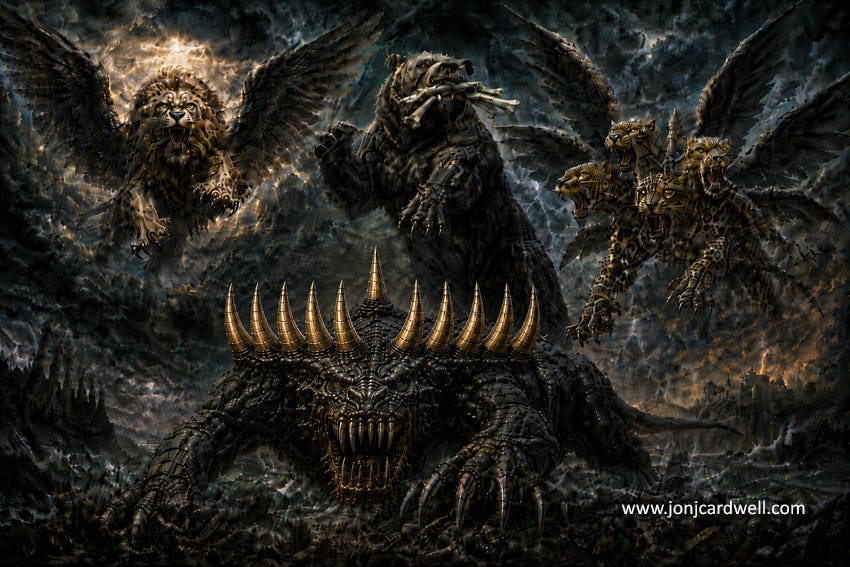
The First Beastly Kingdom
The first kingdom, Babylon, seen by Nebuchadnezzar in Daniel 2 as an image of a man with a head of gold, is depicted as a lion with eagles’ wings (Dan 7:4). A lion was not created with wings, which should indicate to us its impurity from a heavenly perspective. At the same time it presents the character of the empire at its height. The lion has always conveyed power and strength. And while our Lord Messiah is called the “Lion of the Tribe of Judah” (Gen 49:9; Rev 5:5), a Christo-centric interpretation of Scripture would not allow us to assign Christ’s power, beauty, and majesty to an idolatrous empire. No, this is Satan’s counterfeit, as it fits with his antichrist attributes, as it is written:
Be sober-minded; be watchful. Your adversary the devil prowls around like a roaring lion, seeking someone to devour. 1 Peter 5:8
The devouring nature of Satan in the Babylonian Empire was strong, powerful, and fierce, like a lion. The wings represent the kingdom’s swiftness (Jer 48:40; Lam 4:19); but more than that, it fulfilled exactly what the Law of Moses said would happen to the children of Israel in their obstinate unbelief and disobedience toward YHVH God:
“The LORD will bring a nation against you from far away, from the end of the earth, swooping down like the eagle, a nation whose language you do not understand, a hard-faced nation who shall not respect the old or show mercy to the young.” Deuteronomy 28:49-50
The wings, however, were plucked off. Some commentators, such as Dr. John Gill, suggest that this was symbolic of the decline of the kingdom until its subjugation to the Medo-Persian Empire. I don’t argue against that contribution at all. Nevertheless, I believe the Rev. A. R. Fausset, contributor to the commentary by Jamieson, Fausset, and Brown, has certainly hit on the hope in Christ that lies within every beastly empire: salvation of souls by God’s grace through Christ.[vi] Mr. Fausset also suggests that it seems to speak of the head of that kingdom, Nebuchadnezzar, who in Daniel 4, gives testimony as foretold to him by God through a dream and interpreted by Daniel, how he lived as an animal for seven years, out of his mind, but was finally saved by God’s grace and given a mind of a man, walking upright as one made in the image and after the likeness of God (Gen 1:26), humbly worshipping God as the One and only God, worthy to receive all praise, honor, and glory (Dan 4:37).[vii]
The Second Beastly Kingdom
The second kingdom, Medo-Persia, seen by Nebuchadnezzar in Daniel 2 as an image of a man with a chest and arms of silver, was like a bear raised up on one side, having three ribs between its teeth, and told to “devour much flesh” (Dan 7:5). The Chaldean word for bear is the same as the Hebrew word, דֹּב (dōv).
The fierce infamy of the bear from Scripture is often aligned with the lion, immediately following afterward in a verse or sentence, denoting its vicious disposition second only to the lion, as in passages such as this:
Like a roaring lion or a charging bear is a wicked ruler over a poor people. Proverbs 28:15
This proverb is appropriate for the vision found in Daniel since the 70-year Jewish captivity fell under the reign of the Babylonians (roaring lion) and the Medo-Persians (a charging bear).
As the Medo-Persian Empire was made up of the two kingdoms, Media and Persia, united into one, many commentators suggest that the bear being “raised up on one side” denotes the empire’s Persian predominance. Historically, the Persian predominance does seem to fit. After several years in Alaska, and observing not a few brown bears in the wild, it would seem that the rising up of one side of the bear would indicate its power and aggression, the bear rising up on its hind feet. The Persian culture being the most predominant in the empire, is reflective of the head being raised up when a bear stands on its hind feet.
Moreover, both biblically and historically, the Persians were stronger and more cruel than their predecessors, as possibly indicated by “three ribs in its mouth between its teeth.” Mr. Fausset cites Sir Isaac Newton’s commentary on Daniel, who stated that the ribs represented the devouring of Babylon, Lydia, and Egypt by the Medo-Persian Empire.[viii] This seems to fit the historical record. As far as Persian cruelty is concerned, the Persians took the concept of the Assyrians impaling their victims upon sharpened, upright stakes, and turned it into a more sophisticated form of execution by erecting a single wooden pole and nailing persons to be punished upon it. We see this in Haman’s hatred of Mordecai:
Then his wife Zeresh and all his friends said to him, “Let a gallows fifty cubits high be made, and in the morning tell the king to have Mordecai hanged upon it. Then go joyfully with the king to the feast.” This idea pleased Haman, and he had the gallows made. Esther 5:14
Our English word “gallows” is translated from the Hebrew word עֵץ (ātz), which literally means “tree.” It was also the Hebrew word for cross, which the apostle alludes to when he quotes Deuteronomy 21:22 in writing to the Christian believers at Galatia,
Christ redeemed us from the curse of the law by becoming a curse for us—for it is written, “Cursed is everyone who is hanged on a tree”— Galatians 3:13
Later, the Greeks adopted this form of execution, which was later adopted and perfected by the Romans with the familiar Latin cross.
The Third Beastly Kingdom
The third kingdom, Greece, seen by Nebuchadnezzar in Daniel 2 as an image of a man with its middle and thighs of bronze, was a like a leopard with four wings on its back, as well as having four heads (Dan 7:6). Dominion was also given to this beast.
The Chaldean word for leopard is the same as the Hebrew word, נָמֵר (na-MĀR). But this beast is rather grotesque and monstrous. Of course, in the natural, a leopard does not have wings; and this one has four. The four wings indicate the speed in which Alexander the Great conquered the world: only 13 years. After ascending to the throne in 336 BC at the age of 20, his active military campaigns began in 334 BC, ending at his death in 323 BC when Alexander was 32 years old. All the reputable commentaries agree that the four heads of the leopard represent the kingdom being doled out to Alexander’s four generals, fulfilling another vision of Daniel’s (Dan 8:8, 22). The kingdom’s Greek successors to Alexander were Antigonus, ruling over the Macedonian portion of the empire; Ptolemy, ruling over the Egyptian portion of the empire; Seleucus, ruling over the Syrian portion of the empire; and Attalus ruling over the empire containing western Asia Minor.
Dominion was given to the Greek Empire by God; of course, for His gospel plans and purposes. By his military conquests, Alexander left military leadership to govern every place he conquered; and those leaders spoke Koine Greek. By necessity, the language spoken by those living under the dominion of the Greek Empire was Koine Greek. One of the blessed results of this caused for Koine Greek to be the common language in the first century; and thus, becoming the written language for our Christian New Testament.
The Fourth Beastly Kingdom
Daniel especially “desired to know the truth of the fourth beast, which was different from all the rest” (Dan 7:19a), which he continues to describe again, but with a little more detail. This fourth monster was…
“…exceedingly terrifying, with its teeth of iron and claws of bronze, and which devoured and broke in pieces and stamped what was left with its feet, 20and about the ten horns that were on its head, and the other horn that came up and before which three of them fell, the horn that had eyes and a mouth that spoke great things, and that seemed greater than its companions. 21As I looked, this horn made war with the saints and prevailed over them, 22until the Ancient of Days came, and judgment was given for the saints of the Most High, and the time came when the saints possessed the kingdom.” Daniel 7:19b-22
The one who had explained the vision further revealed information about the fourth beast:
23‘As for the fourth beast, there shall be a fourth kingdom on earth, which shall be different from all the kingdoms, and it shall devour the whole earth, and trample it down, and break it to pieces. 24As for the ten horns, out of this kingdom ten kings shall arise, and another shall arise after them; he shall be different from the former ones, and shall put down three kings. 25He shall speak words against the Most High, and shall wear out the saints of the Most High, and shall think to change the times and the law; and they shall be given into his hand for a time, times, and half a time. 26But the court shall sit in judgment, and his dominion shall be taken away, to be consumed and destroyed to the end. 27And the kingdom and the dominion and the greatness of the kingdoms under the whole heaven shall be given to the people of the saints of the Most High; His kingdom shall be an everlasting kingdom, and all dominions shall serve and obey Him.’ Daniel 7:23-27
The fourth kingdom, Rome, seen by Nebuchadnezzar in Daniel 2 as an image of a man with its legs of iron and its feet of iron and clay, was a like a terrifying, unearthly beast with iron teeth, devouring and breaking with its iron teeth, and stamping the remnant with its feet; and the beast also had ten horns (Dan 7:7). Then another horn rose up among them, which had eyes like a man, and from its mouth it spoke great things; and three of the first ten horns were plucked up before this little horn (Dan 7:8).
The Ten Horns of Daniel 7
Dr. MacArthur’s Bible Commentary states this of the seventh and eighth verses:
Daniel 7:7
fourth beast. No such animal exists; rather, this is a unique beast pointing to the Roman Empire, already represented by iron in Dan 2:40 and devastating in conquest. Roman dominion fell apart in A.D. 476, yet it lived on in a divided status (Europe), but will be revived and return to great unified strength near Christ’s second coming. Then it will be comprised of the ten parts under kings (Dan 7:7, Dan 7:24), as well as an eleventh king, the Antichrist (Dan 7:8, Dan 7:24; 2 Th 2:3-10; Rev 13:1-10).[ix]
Daniel 7:8
another horn. This describes the rise of Antichrist (cf. Dan 7:20). This beast is human (“eyes like a man” and a “mouth speaking”) and is proud (cf. Rev 13:5-6).[x]
Dr. MacArthur’s notes on this are obviously from a futurist view. Granted, something of this nature may occur in some time yet future; and as I’ve preached for years, as well as written in this series, we should not be dogmatic about something that has not happened yet. Therefore, I concede that Dr. MacArthur’s explanation could be a possibility. Moreover, the second part of the twenty-first verse and twenty-second verse, may imply a futurist view, according to many eschatological dispensationalists, such as the late Dr. MacArthur:[xi]
As I looked, this horn made war with the saints and prevailed over them, until the Ancient of Days came, and judgment was given for the saints of the Most High, and the time came when the saints possessed the kingdom. Daniel 7:21-22
We’ll look at those two verses more closely in a moment. At this point, I am reluctant to use anymore of Dr. MacArthur’s commentary in this article for three reasons. The first reason is that we’re constrained by space; the second, any more than the excerpts already cited may cause me to violate copyright restrictions; and third, which I’ve written before, these articles are not meant to be a personal attack on the late John MacArthur.[xii]
The Ten Kings from a Partial Preterist View
Now, let’s look at these ten horns from a Christ-centered, partial preterist view.
If the kingdoms in the dream of Nebuchadnezzar from Daniel 2 corresponds to the kingdoms from the vision of Daniel 7, then we can safely presume to correlate the timing of the two perspectives, the dream of Nebuchadnezzar being earthly and idolatrous and the vision of Daniel being heavenly and monstrous. Remember, the idol of precious-metal empires was destroyed by the Stone of Jesus Messiah striking at the feet of the toes made of iron and clay, crushing the entire idol to dust, and the Stone growing to fill the whole earth.
We noted from Scripture at the end of Part Four of this series that Christ Jesus was born during the reign of Augustus Caesar. Tiberius became emperor in 14 AD; so, when Jesus began His earthly ministry in the 15th year of Tiberius Caesar (Luke 3:1) at “about” 30 years of age (Luke 3:23),[xiii] His ministry began in 28 AD (probably in autumn around the Feast of Tabernacles).[xiv]
Having established that the first advent of the Lord Jesus occurred during the reign of Tiberius Caesar from Scripture, we know that historically, there were ten emperors of the Roman Empire in the first century from Tiberius to Domitian. Those ten emperors, or “kings,” were Tiberius (14-37), Caligula (37-41), Claudius (41-54), Nero (54-68), Galba (68-69), Otho (69), Vitellius (69), Vespasian (69-79), Titus (79-81), and Domitian (81-96).
In our first description of the ten horns, Daniel writes that “three of the first horns were plucked up by the roots” (Dan 7:8). In the second description, Daniel writes that the ten horns were on the beast’s “head,” (Dan 7:20), indicating the authority of these horns, or as explained by the one standing before the Ancient of Days,
‘As for the ten horns, out of this kingdom ten kings shall arise, and another shall arise after them; he shall be different from the former ones, and shall put down three kings.’ Daniel 7:24
This seems to suggest not a confederation of kings living at the same time, but successive kings arising one after another, just as the eleventh king arises after these ten kings.
Of the three kings that are uprooted (Dan 7:8), in his second description Daniel uses different Chaldean words, writing,
and about the ten horns that were on its head, and the other horn that came up and before which three of them fell, the horn that had eyes and a mouth that spoke great things, and that seemed greater than its companions. Daniel 7:20
The three kings “fell” (Dan 7:20). They were also “plucked up by the roots” (Dan 7:8). Yet in the explanation, there were three kings that were also “put down” by the later eleventh king (Dan 7:24). Three different Chaldean terms are used in each instance. I suggest that the first two found in verses eight and twenty, when combined, provide a historical reference for the ten kings. They fell because they died, but they were also plucked up by the roots because they were assassinated. The last reference in verse twenty-four presents a characteristic of the eleventh king who comes up after them.
Before I go on with the history of the Roman emperors, I should address the scriptural elephant in the room, since I stated that it doesn’t seem (to me) to be a confederation of kings as opposed to my suggestion of a succession of kings in the Roman Empire during the first century. Daniel 7:20 states: “and the other horn that came up and before which three of them fell.” Some eschatological dispensationalists may argue and before, the Chaldean phrase מן־קדמיה (min_ qa-da-MA-yah), could mean “from [his] presence,” implying that these three kings fell during the eleventh king’s reign. While I concede that the Chaldean root קֳדָם (qad-AM) may mean “presence” or even “before,” the word coupled with it, the Chaldean root מִן (min), can mean a lot of things: before, after, because, since, upon, when, for, from, etc. I suggest that it means “from,” as in not in the times of the first ten kings; or “after,” as in after the times of the first ten kings. I believe that the history of the ten Roman emperors will bear that out.
Additionally, the eschatological dispensationalist may also reinforce that argument because of the phrase, “and that seemed greater than its companions,” or “whose look was more stout than his fellows” (KJV). The English words “companions” or “fellows” is translated from the Chaldean phrase מן־חברתה (min_chav-RA-tah), which can mean fellows, companions, or associates. While I concede that the root word, חַבְרָה (chav-RAH), means “companion” or “associate” and may convey the idea of a confederated fellowship or an association not only in proximity, but also in time, I suggest that the Chaldean min coupled with the word provides a consistent distance in time and difference in character with those ten previous kings. For example, since we are eternal people in Christ, as a Reformed Baptist, many Christian brothers may consider me a fellow, companion, or an associate with brethren such as John Bunyan (1628-88) or Charles Spurgeon (1834-92). Yet my birth is distanced from theirs as well as my proximity; nevertheless, these two men have been two of my greatest teachers by what they’ve written and preached concerning Christ.
Perhaps the above phraseology carries both meanings, so that both near and future fulfillment are possible. I acquiesce to that. Nevertheless, the evidence of a near and partial fulfillment exists through even a cursory historical examination, which should thrill our souls for the details in God’s prophetic plan to be glorified through His only Son, Christ Jesus.
Now, returning to the three kings that both fell and were also plucked up by the roots, I would take this to mean that three of the emperors of Rome from the time of Tiberius to Domitian were assassinated, which is true and a matter of world history.
So, between 14-96 AD, the first emperor of the Roman Empire to be assassinated was Caligula, who was assassinated by the Praetorian Guard in 41 AD.[xv] He was succeeded by Claudius, but Claudius was not assassinated in a political plot, he was poisoned.[xvi] Claudius was succeeded by Nero, and while he was deposed by the Senate and declared a public enemy to the state, Nero fled and took his own life in 68 AD. Nero was succeeded by Galba, who was assassinated in 69 AD during a military revolt by soldiers supporting Otho. Otho ascended to the throne as Caesar with the support of his military forces. After the forces under Vitellius defeated Otho in a civil war that same year, 69AD, Otho committed suicide after his defeat. Vitellius succeeded Otho, but later that same year, 69 AD, he was captured by Vespasian’s forces, tortured, then executed.[xvii] Vespasian ruled as emperor until his death of natural causes in 79 AD. He was succeeded by Titus, who ruled until his death from an illness in 81 AD. Titus was succeeded by Domitian, who ruled from 81-96 AD. He was assassinated on September 18, 96 AD in a plot conspired chiefly by his chamberlain, Parthenius, and other palace officials. Caligula, Galba, and Domitian were three Roman emperors during the first century who were assassinated since the coming of Christ.
These ten Roman emperors, from Tiberius to Domitian, cover the period that includes the conception, birth, life, death, resurrection, and ascension of the Lord Jesus Christ through the birth of His church, the writing of the New Testament Scriptures, the destruction of the temple in Jerusalem by Titus in 70 AD,[xviii] and the death and witness of His apostles. As we can see from the brief history above, three Roman emperors of the ten were assassinated, plucked up by the roots as foretold by Daniel in this vision. And we should rejoice with joy unspeakable for the accuracy of such prophecy revealed by God so many years before it occurred.
The Eleventh Horn
As the ten horns at least fit into a partial preterist view, we should consider that the eleventh horn of Daniel 7 also points to a historical figure, a Roman emperor who had risen three Caesars after Domitian. Following Domitian, there was Nerva (96-98). Nerva was succeeded by Trajan (98-117). Trajan was succeeded by Hadrian (117-138).
Hadrian fits as a fulfillment of the eleventh horn. The king in Daniel’s vision would possess “a mouth speaking great things” (Dan 7:8). This was one of Hadrian’s weaknesses. He was such a failure at oratory that he determined to master the art of speaking. He studied Latin and rhetoric with a feverish rigor. While he did become quite fluent in speech, and articulate in conveying his thoughts, critics of his speeches and orations deemed him pretentious, even pompous. This would seem to fulfill “a mouth speaking great things.”
Caesar Hadrian was a pagan, serving a multitude of Roman deities, himself worshiping the “Capitoline Triad,” the central state-god grouping of Jupiter, Juno, and Minerva. While visiting Jerusalem on his way to Egypt in 130-132 AD, he ordered the erection of a temple for Jupiter on the flattened temple mount, the plans formulated in 130 during his travels after his first visit to Jerusalem, and construction beginning in 132 on his journey through Jerusalem on his way back to Rome.[xix] He also erected statues of himself on the temple mount, one upon the spot believed to be at the time the place of the Holy of Holies. His fiery and aggressive idolatry as Rome’s religious Pontifex Maximus caused him to blaspheme the Triune God, fulfilling this portion of Daniel’s interpreted vision that said,
‘He shall speak words against the Most High…’ Daniel 7:25a
And though some online sources speak well of Hadrian, suggesting that he did not oppose Christians or Christianity per se, Jewish Christians were still viewed as Jews during the Bar Kokhba Revolt, and were arrested, executed, or killed in skirmishes by Hadrian’s army. The ancient historian, Eusubius, wrote of Caesar Constantine (272-337 AD) destroying a shrine to Venus, which was built over site of Christ’s empty tomb, presumably erected during the reign of Hadrian.[xx] After destroying the shrine, Constantine built the Church of the Holy Sepulcher in its place.
Now, the early church father, Ignatius, among others, suffered and was martyred under Trajan’s persecution of Christian believers, Trajan being Hadrian’s predecessor. Hadrian continued in Trajan’s attitude toward Christians as well, martyring “about ten thousand” Christians, cited by John Foxe:
Trajan being succeeded by Adrian, the latter continued this third persecution with as much severity as his predecessor. About this time Alexander, bishop of Rome, with his two deacons, were martyred; as were Quirinus and Hernes, with their families; Zenon, a Roman nobleman, and about ten thousand other Christians.
In Mount Ararat many were crucified, crowned with thorns, and spears run into their sides, in imitation of Christ’s passion. Eustachius, a brave and successful Roman commander, was by the emperor ordered to join in an idolatrous sacrifice to celebrate some of his own victories; but his faith (being a Christian in his heart) was so much greater than his vanity, that he nobly refused it. Enraged at the denial, the ungrateful emperor forgot the service of this skillful commander, and ordered him and his whole family to be martyred.
At the martyrdom of Faustines and Jovita, brothers and citizens of Brescia, their torments were so many, and their patience so great, that Calocerius, a pagan, beholding them, was struck with admiration, and exclaimed in a kind of ecstasy, “Great is the God of the Christians!” for which he was apprehended, and suffered a similar fate.[xxi]
This fulfilled the Scripture from Daniel’s vision,
‘…shall wear out the saints of the Most High…’ Daniel 7:25b
The interpretation of Daniel’s vision also stated that this eleventh king “shall think to change the times and the law” (Dan 7:25). While Hadrian did change the laws in Rome with the Edictum Perpetuum, which in short, limited local magistrate power, codified Roman laws throughout the empire, and centralized legal authority under the emperor himself. This is only part of what I believe this portion of Scripture was alluding to (which I’ll explain in a moment). The Chaldean word “times” is key to this first part because it means “seasons” or “appointed times.” Hadrian changed the seasons or appointed times in Jerusalem, as well as the Law of Moses governing the Jews who lived there. He issued decrees that outlawed Scripture study, possessing Scripture, and circumcision. Moreover, he changed “times” for both Jews and Christians by forbidding synagogue worship and Sabbath keeping, including all the Feasts of YHVH (Lev 23; Deut 16). The Law of Moses required all male Jews to present themselves before YHVH three times a year in Jerusalem (Ex 12:14, 17; 34:23), but under Hadrian, Jews were required to visit Jerusalem only once per year on the 9th of Av, the anniversary of the destruction of the temple. Scripture scrolls were burned and synagogues were destroyed. The Old Testament scrolls were as sacred to Christians as they were to the non-Christian Jews, and therefore, Hadrian becomes a fulfillment of the Scripture,
‘…and shall think to change the times and the law…’ Daniel 7:25c
Now, in changing the law in Rome, also alluding to Hadrian’s Edictum Perptuum, being coupled with the ten previous kings, whereas it is explained to Daniel that ‘another shall arise after them; he shall be different from the former ones, and shall put down three kings’ (Dan 7:24), the Chaldean word “shall put down” is a different word from the words used previously concerning them, “plucked up by the roots” (Dan 7:8) and “fell” (Dan 7:20). Without going back to the original languages, the conclusion some have come to is that if the eleventh horn rises after the ten horns, they must exist together, and that this eleventh king deposed, removed, or somehow “put down” (ESV) or “subdue” (KJV) three of the ten kings. The Chaldean root word used in the twenty-fourth verse, however, is שְׁפַל (shef-AL). It means to “shame” or “humiliate.”
By his Edictum Perpetuum, Hadrian effectively changed three laws that were used by three of the previous emperors, shaming their memories during his reign; so much so, the Senate was at odds with him, even hated him toward the end of his reign.
The first emperor Hadrian shamed was Tiberius, by stripping Praetorium Discretion. The Praetorium, or Military Headquarters, was free to interpret the laws governing Rome at their discretion. The Praetorium Discretion grew in strength through emperors before Tiberius, but it was during his reign that Praetorium Discretion was solidified and used by the emperors who followed him. It was by Praetorium Discretion that Pilate could wield the power he possessed in the crucifixion of Christ.
The second emperor he humiliated was Nero, by overturning Master-Slave Law. The law stated that if a master was murdered at home, every slave in the household was automatically executed. While the law was established by Caesar Augustus in 10 AD, Nero was the harshest enforcer of it. In 61 AD, when the city prefect, Lucius Pedanius Secundus, was murdered in his home, Nero commanded 400 slaves under his household to be executed despite public protest.
The third emperor Hadian disgraced was Domitian, by abolishing the Treasury’s claim on assets. While the practice of seizing estates of prosecuted and executed citizens for the emperor’s imperial fiscus was utilized by several Caesars before Domitian, Domitian was the most notorious. According to Suetonius, Cassius Dio, and Pliny, Domitian confiscated property for trivial infractions of the law, and even had senators executed under the accusations of plotting revolution.
Romans in the first century, especially the aristocratic elite, deeply valued history, as evident by the number of ancient historians who wrote upon that era.[xxii] For Romans, history was tied to memory, moral instruction, ancestral tradition, public honor, political legitimacy, and warning. So, Hadrian’s edict that overturned these laws would have been seen by those aristocrats who prided themselves on recent Roman history as shameful, humiliating, and embarrassing put-downs upon the three earlier Caesars, Tiberius, Nero, and Domitian. Thus, Hadrian fulfills the Scripture,
‘another shall arise after them; he shall be different from the former ones, and shall put down three kings’ Daniel 7:24b
The Bar Kokhba Revolt
Hadrian was the Caesar in power when Shimōn bar Khōkhva (שִׁמְעוֹן בַּר כּוֹכְבָא), or Simon bar Kokhba, led a rebellion against the Roman Empire in 132 AD. While bar Kokhba never directly confessed to being the Messiah, he did sign his letters as the “Prince of Israel.”[xxiii] Several religious leaders promoted him as “prince,” including one Rabbi, Aqiva ben Yosef (עֲקִיבָא בֶּן יוֹסֵף), or Akiva ben Joseph (c.50-135 AD), who was the well-known scholar that contributed commentary to the Jewish Torah Mishnah and Midrash Halakha. Akiva actively and openly endorsed bar Kokhba as the Messiah. The revolt lasted three-and-a-half years, beginning in the autumn of 132 AD, lasting until the death of Simon bar Kokhba and the plowing under of Jerusalem in the summer of 135 AD. This would seem to fulfill the portion of Scripture from Daniel’s vision and its interpretation that says,
‘…and they shall be given into his hand for a time, times, and half a time.’ Daniel 7:25d
The day the revolt ended was the day Simon was killed by Roman forces. That day was the 9th of Av on the Jewish lunar calendar. That was the same day that the first temple was destroyed in 586 BC by Nebuchadnezzar. It was also the day the second temple was destroyed in 70 AD by the Roman general, Titus, who later became Caesar in 79 AD. The Jews, even today, consider the 9th of Av the darkest day in Jewish history.
Jewish believers in Christ were not only persecuted under Hadrian, but they were also persecuted by Simon bar Kokhba and his leaders. The early church father, Justin Martyr (c.90-165 AD), referring to Simon bar Kokhba as “Barchochebas,” wrote:
For in the Jewish war which lately raged, Barchochebas, the leader of the revolt of the Jews, gave orders that Christians alone should be led to cruel punishments, unless they would deny Jesus Christ and utter blasphemy.[xxiv]
Of bar Kokhba’s character, the early church historian, Eusebius (c.260-339 AD), wrote:
The Jews were at that time led by a certain Bar Chochebas, which means ‘star,’ a man who was murderous and a bandit, but relied on his name, as if dealing with slaves, and claimed to be a luminary who had come down to them from heaven and was magically enlightening those who were in misery.[xxv]
Eusebius also confirms Justin Martyr’s testimony of the Bar Kokhba Revolt and wrote:
The same writer mentions the war of that time against the Jews and makes this observation, “For in the present Jewish war it was only Christians whom Bar Chocheba, the leader of the rebellion of the Jews, commanded to be punished severely, if they did not deny Jesus as the Messiah and blaspheme him.”[xxvi]
Judgment for the Saints
Hadrian’s persecution of Christians, however, ended sometime before his death. John Foxe, once again, gives us this insight:
Many other similar cruelties and rigors were exercised against the Christians, until Quadratus, bishop of Athens, made a learned apology in their favour before the emperor, who happened to be there and Aristides, a philosopher of the same city, wrote an elegant epistle, which caused Adrian to relax in his severities, and relent in their favour.
Adrian dying A.D. 138, was succeeded by Antoninus Pius, one of the most amiable monarchs that ever reigned, and who stayed the persecutions against the Christians.[xxvii]
This would seem to fulfill the passage of Scripture we cited but had not yet attended to:
As I looked, this horn made war with the saints and prevailed over them, until the Ancient of Days came, and judgment was given for the saints of the Most High, and the time came when the saints possessed the kingdom. Daniel 7:21-22
Hadrian prevailed over Christians until God (the Ancient of Days) spoke through Quadratus by the Holy Spirit and ministered unto Hadrian to relax and relent from his severe persecution. Persecutions continued under seven more Caesars, until Constantine became emperor in 306 AD, and then issued an edict of religious tolerance in February 313 AD, which effectively allowed Christianity to be legalized in the empire. John Foxe wrote:
Thus Constantine, sufficiently appointed with strength of men but especially with strength of God, entered his journey coming towards Italy, which was about the last year of the persecution, A.D. 313.[xxviii]
Master Foxe also added this:
Constantine so established the peace of the Church that for the space of a thousand years we read of no set persecution against the Christians, unto the time of John Wickliffe.[xxix]
Tribulation has been promised to the Christian believer. It is by that tribulation that Christ’s church has grown, and the individuals therein may grow in grace and be strengthened if faith (Rom 8:28-29). Jesus Himself said,
“I have said these things to you, that in Me you may have peace. In the world you will have tribulation. But take heart; I have overcome the world.” John 16:33
Persecution is a promise of the true gospel of Christ as well, as it is written,
Indeed, all who desire to live a godly life in Christ Jesus will be persecuted, while evil people and impostors will go on from bad to worse, deceiving and being deceived. 2 Timothy 3:12-13
By the tribulation and persecution the saints of Christ suffered, not only under Hadrian, but under the rule of six other Roman emperors after him, the gospel was spread throughout the empire, Christ’s church grew stronger, and Christ’s people grew more faithful. The Ancient of Days had indeed come and given judgment to God’s people, because by the persecution and tribulation they suffered, believers in those days could cling to two spiritual truths; first, the intervention of the Ancient of Days through His Messiah, as it is written,
Keep your life free from love of money, and be content with what you have, for He has said, “I will never leave you nor forsake you.” Hebrews 13:5
And second, the possession and ownership of Christ’s kingdom belongs to every saint in Christ since we’ve believed. It’s reality, however, comes by revelation from heaven above; and the catalyst often used by our God and Father are the trials, tribulations, persecutions, and hatred from the unbelieving world. About that possession and judgment given into our hands, it is written,
even when we were dead in our trespasses, made us alive together with Christ—by grace you have been saved—and raised us up with Him and seated us with Him in the heavenly places in Christ Jesus, so that in the coming ages He might show the immeasurable riches of His grace in kindness toward us in Christ Jesus. Ephesians 2:5-7
One last thing I must include about the eleventh horn of this vision. Many eschatological dispensationalists suggest that this is the antichrist to come at the end of the last days.[xxx] Yes, the Scriptures speak of one who claims to be Christ, but isn’t.[xxxi] But there have been many in history. Simon bar Kokhba was an antichrist; because antichrist doesn’t mean “against Christ,” it means “in place of Christ” or “instead of Christ.”
Antichrist is simply idolatry personified. And idolatry, the second commandment of the Ten Commandments, is the chief sin, upon which all other sins is manifested. Idolatry is simply covetousness (Col 3:5). It is anything that competes with or detracts from supreme loyalty to Christ Jesus. And every sinner, whether reprobate or redeemed by the blood, has a propensity toward idolatry until the Lord Jesus comes again or takes us home.
I have a real hard time believing that the eleventh horn is the antichrist to come. Not only does Hadrian fit the bill for fulfilling the prophecy of a king from the Roman Empire, but the antichrist to come will be Jewish. There is no way that the Jews of the nation-state of Israel are going to hail a Messiah that is not a Jew or a descendant of David.
Although I won’t get into the details of this, the prophetic foreshadows from the Old Testament are many. Judah, the fourth son of Jacob, before he became a type of Christ (Gen 43:8-9), was a type of antichrist when he betrayed his brother Joseph and sold him for silver (Gen 37:26-27). Abimelech rose up to make himself king over Israel for three years (Judg 9:1-57), making him a type of antichrist. Absalom, the son of David was a type of antichrist, usurping the throne of his father, using flattering words when he spoke to the people (2 Sam 15:4-10). Ahithophel, David’s counselor, betrayed him by siding with Absalom in the usurpation, making him a type of antichrist (2 Sam 15:12; Psa 41:9; 55:12-14). Judas Iscariot, who betrayed the Lord Jesus, was a type of antichrist (Luke 22:48; John 6:70-71; 17:12). The antichrist to come will be a Jew, and like Judas Iscariot, he will be the one no one suspects to be the traitor. Remember, Judas kept the money bag (John 12:4-6). You don’t make the one least trusted your treasurer.
The End of the Explanation of the Vision
‘But the court shall sit in judgment, and his dominion shall be taken away, to be consumed and destroyed to the end. And the kingdom and the dominion and the greatness of the kingdoms under the whole heaven shall be given to the people of the saints of the Most High; His kingdom shall be an everlasting kingdom, and all dominions shall serve and obey Him.’ Daniel 7:26-27
These last two verses from the one who stood before the throne of the Ancient of Days and explained the vision to Daniel seems to speak of a time that relates to the antichrist who will come at the end of the last days. We have been in the last days for 2,000 years according to Scripture (Acts 2:17; Heb 1:2; Jas 5:3; 1 Pet 1:20; 1 Jn 2:18).
Given what we have looked at in the entirety of this article from this vision given to Daniel, we should conclude that the eyes of our faith should not be upon Israel, not upon the empires of the world, nor upon the antichrist. Our eyes should be upon Christ.
And after writing all I have written, and you, dear Reader, patiently reading these words for all this time, we still have not covered the very heart of this chapter, Daniel 7:9-14, the revelation of the Son of Man coming in clouds. We’ve gone too long here, but that’s appropriate; for after all of this, we want to take a deep breath and spend an entire article on Jesus Messiah, the בר אנשׁ (bar en-ASH), or the “Son of Man” of Daniel 7:13. We will look at that next time.
Conclusion
World empires are monstrous; beastly from a heavenly perspective, because all of them are made up of sinners, both reprobate and redeemed. Even after the worldwide deluge, YHVH God said in His heart,
“I will never again curse the ground because of man, for the intention of man’s heart is evil from his youth. Neither will I ever again strike down every living creature as I have done. While the earth remains, seedtime and harvest, cold and heat, summer and winter, day and night, shall not cease.” Genesis 8:21
Even witnessing God’s worldwide judgment didn’t straighten man out. Noah planted a vineyard and got drunk (Gen 9:20-21), which in turn, caused his son, Ham, to dishonor his father (Gen 9:23). What makes us think that mere men can form a more perfect union, establish justice, ensure domestic tranquility, provide for the common defense, promote the general welfare, and secure the blessings of liberty to ourselves and our posterity? Who wouldn’t want that? On the other hand…
…it seems rather silly when we have just read what kinds of governments the people of God had to endure regarding Daniel’s vision in chapter 7. More than that, when we consider the birth of Christianity, by the Son of God being born of a virgin in the fullness of time (Gal 4:4) into a political economy coupled with religious fanatics that put Him to death on a cross, and then seeing how that government murdered thousands upon thousands of Christ’s followers, it should chill us to the core and sober us from the soles of our feet to the crown of our heads. Human government will not save us, as it is written,
Put not your trust in princes, in a son of man, in whom there is no salvation. Psalm 146:3
Read “Understanding Israel from Scripture, Part One” by clicking here.
Read “Understanding Israel from Scripture, Part Two” by clicking here.
Read “Understanding Israel from Scripture, Part Three” by clicking here.
Read “Understanding Israel from Scripture, Part Four” by clicking here.
ENDNOTES
[i] See my devotional thought on Genesis 4:2 about Cain’s slavery to the earth and his own self-exalted opinion of himself by clicking here. See also my devotional thought on Genesis 4:3-4 about the offerings of Cain and Abel in worship by clicking here.
[ii] While Joseph, the son of Jacob, was a reigning leader in Egypt (Gen 41:40), while Daniel was a statesman in both the Babylonian and Medo-Persian empires (Dan 9:42; 5:29; 6:1-2; 8:27), and while the Apostle Paul was a Roman citizen, none of these ever used their positions of authority or rights as citizens to change the political system of government. Regarding Paul, we should keep in mind that the only times Paul leveraged his citizenship was for the sake of the gospel (Acts 16:37; 21:39; 22:25-26; 25:10-11).
Moreover, the Jesus of Nazareth was, is, and evermore shall be King of kings. He never exercised His authority to overthrow the Roman government, nor did He restore Israel as a kingdom (Acts 1:6-7). John MacArthur argued in defense of his dispensational theology that if the kingdom were never to be restored, Jesus would have told them at that time (https://www.gracechurch.org/sermons/332). In response to that argument, I argue that the disciples would not have understood because the Holy Spirit had not yet been given, for they were to preach the kingdom of God after having received the Holy Spirit (Acts 1:8).
[iii] Pogo was a syndicated American comic strip created in 1948 by cartoonist Walt Kelly (1913-1973). Fun fact: Walt Kelly and I shared the same birthday, August 25th, for 13 years.
[iv] MacArthur Study Bible; John F. MacArthur, Jr.; Thomas Nelson Publishers, Nashville, TN; © 2005. Unless otherwise indicated, Scripture quotations are from the New King James Version of the Bible, © 1979, 1980, 1982, 1990, Thomas Nelson, Inc., Publishers.
[v] Ibid.
[vi] Jamieson, Fausset and Brown Commentary: A Commentary, Critical and Explanatory, on the Old and New Testaments; Rev. Andrew Robert Fausset, A.M. (1821-1910); 1871
[vii] Ibid.
[viii] Ibid.
[ix] MacArthur Study Bible; John F. MacArthur, Jr.; Thomas Nelson Publishers, Nashville, TN; © 2005. Unless otherwise indicated, Scripture quotations are from the New King James Version of the Bible, © 1979, 1980, 1982, 1990, Thomas Nelson, Inc., Publishers.
[x] Ibid.
[xi] Ibid., notes of Daniel 7:21-22
[xii] With the first four articles published on jonjcardwell.com, I have not yet received correspondence arguing that I “waited until Dr. MacArthur passed away” before writing a critique on his eschatology. If any such argument arises, my defense is that (1) I was a pastor and missionary-pastor for the 25 years from 2000 to 2025 until my retirement on August 25, 2025, so I didn’t have the time to write articles such as these; and (2) I’ve taught and preached these things I’ve written here for many years, much of its content can be found from over 2,200 sermons, messages, and lessons on SermonAudio.com.
[xiii] See the last paragraphs of “Understanding Israel from Scripture, Part Four” to see why Jesus was “about” 30 years of age, eternally speaking, but exactly 30 years old when He began His ministry.
[xiv] We’ll see how this also fits with the “Seventy weeks,” or literal “seventy sevens,” of Daniel 9:24-27 and coincides appropriately with Scripture and the historical timeline, which will be covered in the forthcoming “Part Seven.”
[xv] While there were rumors that Tiberius was murdered, the circumstances surrounding his death are not clear.
[xvi] Claudius was not assassinated in a public, conspiratorial coup. Traditionally, it was believed that his wife, Agrippina poisoned him.
[xvii] There was no plot to assassinate Vitellius. He had already signed an agreement to abdicate as ruler but was turned away by the Praetorian Guard. After the forces of Vespasian suffered numerous casualties entering Rome, when Vitellius was found in hiding, he was tortured on the way to his execution at the Gemonian Stairs.
[xviii] This is that same Titus, who became emperor in 79 AD. Titus was the Roman general who laid a six-month siege upon Jerusalem, surrounding the city, which led ultimately to the destruction of the temple. This fulfilled the Lord Jesus’ words of prophecy, “As for these things that you see, the days will come when there will not be left here one stone upon another that will not be thrown down” (Luke 21:6); and again, “See, your house is left to you desolate” (Matt 23:38).
[xix] While I cannot find any reliable material that states this may have been the catalyst for the start of the Bar Kokhba Revolt, this may have indeed sparked the revolution.
[xx] While Hadrian is not specifically named in Life of Constantine by Eusebius, tradition holds Hadrian and his reconstructionists as the “impious and godless persons” building the shrine to Venus.
[xxi] Foxe’s Book of Martyrs, John Foxe; ch.2, section iii: “The Third Persecution, Under Trajan, A.D. 108”; para. 3-5. “Adrian” cited by John Foxe as the successor of Trajan, is Hadrian.
[xxii] Titus Livius (59BC-17AD); Velleius Paterculus (19BC-31AD); Philo of Alexandria (20BC-50AD); Flavius Josephus (37-100AD); Pliny the Elder (c.23-79AD); Plutarch (c.56-120AD); Tacitus (c.55-c.120AD); Suetonius (c.71-c.135AD); Florus (c.70-c.140AD?); Appian of Alexandria (c.95-c.165AD); Cassius Dio (c.155-c.235AD). And the works of these are lost or fragmentary: Aufidius Bassus, Servilius Nonianus, Cluvius Rufus, Fabius Rusticus.
[xxiii] Simon’s surname, בַּר כּוֹכְבָא (bar khōk-VA), in Aramaic means “son of star,” taken from Balak’s messianic prophecy in Numbers 24:17, “I see Him, but not now; I behold Him, but not near: a Star shall come out of Jacob, and a Scepter shall rise out of Israel; it shall crush the forehead of Moab and break down all the sons of Sheth.” The Hebrew word for “star” is כּוֹכָב (khō-KHAV).
[xxiv] First Apology, Justin Martyr; ch.31 – “Of the Hebrew Prophets” (free online PDF formatted by basilica.org). pg.17
[xxv] Eusebius, The Ecclesiastical History, English trans. by Kirsopp Lake; G. P. Putnam’s Sons, New York; 1926. pgs.311-13
[xxvi] Ibid., pg.339
[xxvii] Foxe’s Book of Martyrs, John Foxe; ch.2, section iii: “The Third Persecution, Under Trajan, A.D. 108”; para. 6-7. “Adrian” cited by John Foxe as the successor of Trajan, is Hadrian.
[xxviii] Ibid., ch.2, section x; “The Tenth Persecution, Under Diocletian, A.D. 303”; para. 46
[xxix] Ibid., ch.2, section x; “The Tenth Persecution, Under Diocletian, A.D. 303”; para. 49
[xxx] As the late John MacArthur did. See endnote #xi.
[xxxi] Matthew 24:4-5, 23-26; Mark 3:16; John 5:43; 2 Thessalonians 2:3-4; 1 John 2:18