
Understanding Israel from Scripture
Answering a Question: “…when God called Jacob ‘Israel,’ what did that mean?”

PREFACE
This paper was written in response to a question concerning “Israel.” Someone asked: “…when God called Jacob ‘Israel,’ what did that mean?” I quickly responded with this:
“I’ll give you a more comprehensive answer later today after church services. But Jacob’s renaming presents several important truths: first, Jacob becomes a type of Christ as it foreshadows the Messiah to come. Jacob was to be ‘governed by God,’ which is what yisrael means. Jesus was the only Man ever completely governed by God (John 8:29). Second, the name was given to a single man, again, to show that salvation comes through a single Man, Jesus. Third, it demonstrates the offspring of Messiah, viz, His progeny would be governed by God, viz, Jesus is the Head of His church; He commands us, not the other way around. There are more things that this speaks of, but it is clear by these three perspectives that modern, unsaved Israel does not fall into this prophetic typology.”
The story of Esau and Jacob was another topic that was queried. It is in the story of these “two nations” where we understand more fully what Israel is about.
THE GOSPEL BACKGROUND OF JACOB
Isaac was 40 years old when he married his wife, Rebekah (Gen 25:20). He was 60 years old when Rebekah bore his sons, Esau and Jacob (Gen 25:26). While Rebekah was pregnant, the two infants “struggled together within her” and she sought the reason for why this was happening, asking YHVH God (Gen 25:22)— asking really, El Shaddai, because YHVH was not known by His name, יְהֹוָה (y’-HŌ-veh), until after He revealed it to Moses at the burning bush of Exodus 3:14 (Ex 6:3). Concerning this, YHVH God answered Rebekah, not Isaac, as it is written:
And the LORD said to her, “Two nations are in your womb, and two peoples from within you shall be divided; the one shall be stronger than the other, the older shall serve the younger.” Genesis 25:23
The LORD answering Rebekah and not revealing this to Isaac will be significant when Isaac gives his blessing to Jacob instead of Esay; but here, in YHVH’s answer, as well as in the birth of the two children, this prophetically foreshadows the gospel of Jesus Messiah. I’ve mentioned this before to you—the firstborn and second born—as Adam to Christ, Cain to Abel, Japheth to Shem, etc. The New Testament illuminates this redemptive thread seen throughout the Hebrew Scriptures:
Thus it is written, “The first man Adam became a living being”; the last Adam became a life-giving spirit. But it is not the spiritual that is first but the natural, and then the spiritual. The first man was from the earth, a man of dust; the second man is from heaven. 1 Corinthians 15:45-47
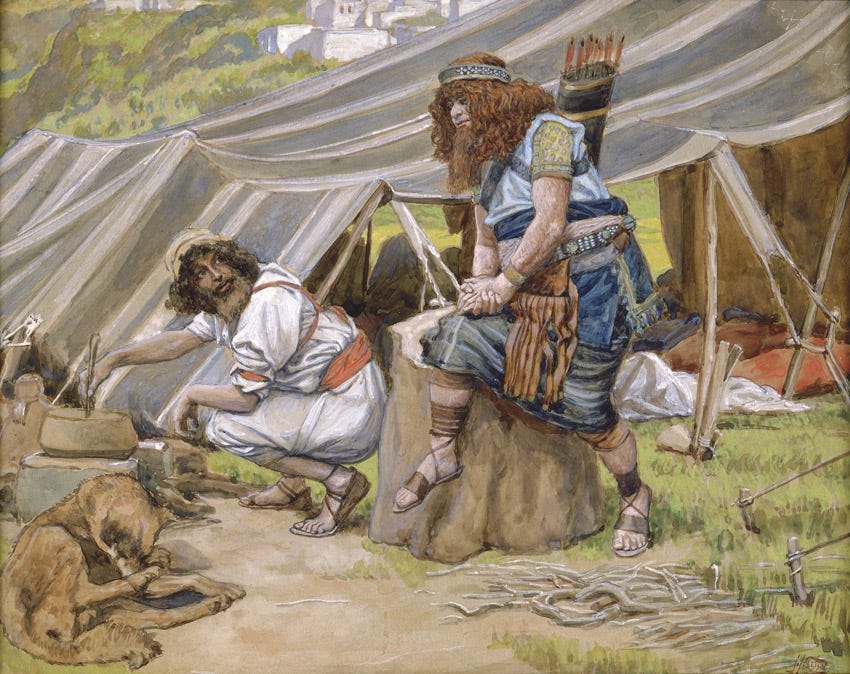
More gospel details are given in Esau and Jacob’s lives. They were named by the revelations from their birth. Esau came forth first, named “Hairy,” עֵשָׂו (ā-SAV) in Hebrew, because he “came out red, all his body like a hairy cloak” (Gen 25:25). Jacob “came out with his hand holding Esau’s heel” (Gen 25:26), so he was called יַעֲקֹב (ya-aq-ŌV), which means “heel catcher” or “supplanter.” Even Jacob’s name is prophetic of the Messiah, because the Messiah would supplant the judgment of sinful Adam by taking on the punishment of sin Himself, suffering God’s holy wrath and dying a shameful death upon Calvary’s tree.
Moreover, we are told that Esau was “a man of the field” (Gen 25:27a); that is, he was a man given over to the world. The scriptural “field” is sometimes an allegorical picture of the sinful world and the sin-cursed ground. The “field” was where Cain slew Abel (Gen 4:8), as well as what Jesus describes in many of His parables as “the world” (Matt 13:24, 31, 38, 44, et al).
The King James Version or Genesis 25:27 renders Jacob’s typology a little better than the English Standard Version in my humble opinion. It states:
And the boys grew: and Esau was a cunning hunter, a man of the field; and Jacob was a plain man, dwelling in tents.
Two prophetic characteristics of Messiah are presented here. Jacob was a “plain man.” In Hebrew, he was אִישׁ תָּם (eeysh tam), translated “plain man” (KJV) or “quiet man.”[1] תָּם (tam) means “undefiled,” and comes from the same root that describes Noah in Genesis 6:9, the Hebrew word תָּמַם (ta-MAM), meaning “unblemished.” Tamam is used when describing an animal sacrifice that was to be unblemished or without spot (Ex 12:5; Lev 1:3; etc). We know this describes Jesus as the Lamb of God (John 1:29), as it is written:
knowing that you were ransomed from the futile ways inherited from your forefathers, not with perishable things such as silver or gold, but with the precious blood of Christ, like that of a lamb without blemish or spot. 1 Peter 1:18-19
This was YHVH God’s plan from before the creation of the heavens and the earth because the next two verses tell us:
He was foreknown before the foundation of the world but was made manifest in the last times for the sake of you who through Him are believers in God, who raised Him from the dead and gave Him glory, so that your faith and hope are in God. 1 Peter 1:20-21
The second characteristic presented here is that Jacob dwelt in tents. In other words, Jacob was a sojourner. Jesus Messiah was the ultimate Sojourner on the planet. Just a few of our proof texts are:
And the Word became flesh and dwelt among us, and we have seen His glory, glory as of the only Son from the Father, full of grace and truth. John 1:14
And Jesus said to him, “Foxes have holes, and birds of the air have nests, but the Son of Man has nowhere to lay His head.” Matthew 8:20
The next blessed gospel picture given us is when Esau’s name is changed to Edom (Gen 25:29-34). Esau had been hunting in the field. He was exhausted, having caught nothing. Jacob had been cooking stew and Esau wanted some of Jacob’s red stew. For payment to receive a bowl of this stew, Esau must sell Jacob his birthright as the firstborn. Thus Esau was called Edom because of the red stew he had purchased. The word red comes from the Hebrew word אָדֹם (a-DŌM), which is the root for the words “earth,” “ground,” “blood,” and the name “Adam.” Edom, Hebrew אֱדוֹם (e-DŌM), becomes a type of Adam, Hebrew אָדָם (a-DAM), because Esau sold his birthright for something to eat—same as Adam.
Next, Jacob again becomes a type of Christ during the blessing from Isaac (Gen 27:1-46). The blessing occurs after Esau and Jacob are forty years old, because Esau was forty years old when he took wives from the daughters of the Hittites (Gen 26:34; 27:46). Isaac was still alive when Jacob returned after twenty years of servitude under Laban in Haran (Gen 31:38-41), Isaac living to be 180 years old (Gen 35:27-29).
So, when the blessing came to Jacob, Isaac was old and blind, but sometime after 100 years of age—5 years? 10? 20? We’re not told. Remember, Isaac doesn’t know anything about the elder serving the younger, so he sends his eldest son out to hunt game and prepare him the delicious food he loves; and then, he will pronounce the blessing upon Esau (Gen 27:1-4), so he thinks.
Rebekah overhears this and sets things into motion. She “commands” Jacob to bring two young goats from the flock (Gen 27:5-10). The slaying of these two kids was a prophetic foreshadow of the Day of Atonement, when two goats are offered before YHVH God (Lev 16:7-10). While the goats were young for Jacob’s episode, and both were slain, it still reminds us of the ancient Yom Kippur.
For the Day of Atonement, lots were cast upon the two goats (Lev 16:7-10). One was l’YHVH, or “for the LORD,” which was sacrificed as an offering to God for sin. The other was l’azazel, or the “scapegoat,” which was set free in the wilderness, carrying the people’s sin away. This reflected the two-fold work of Messiah in the perfect atoning Sacrifice He offered on Calvary’s tree. Christ’s suffering, death, and shed blood satisfied the holy justice of YHVH God for sin. At the same time, Christ’s substitutionary atonement carried our sins away. That this was done by the high priest once per year, it also foreshadowed the two-fold work of Messiah in being both our Great High Priest (Heb 8:1-13) and the once-and-for-all Sacrifice for sin (Heb 10:1-39).
The young goats were used in Jacob’s instance because kids under one year old had fine, soft hair, close to what Esau’s arms and neck felt like. While Rebekah made the delicious food from the goats, she also clothed Jacob in Esau’s garments and put the kid skins on Jacob’s arms and neck (Gen 27:14-17). This picture was a prophetic type of the incarnation of Christ:
And the Word became flesh and dwelt among us, and we have seen His glory, glory as of the only Son from the Father, full of grace and truth. John 1:14
Jacob, the supplanter, received the blessing from Isaac, foreshadowing the blessing redeemed souls would receive through Messiah. It is written:
and behold, a voice from heaven said, “This is My beloved Son, with whom I am well pleased.” Matthew 3:17
And again,
He was still speaking when, behold, a bright cloud overshadowed them, and a voice from the cloud said, “This is My beloved Son, with whom I am well pleased; listen to Him.” Matthew 17:5
Even in the interaction, Isaac speaks of things that prophetically foretell the Messiah. Isaac said to Jacob,
“Please come near, that I may feel you, my son, to know whether you are really my son Esau or not.” Genesis 27:21
Jesus said,
“See My hands and My feet, that it is I Myself. Touch Me, and see. For a spirit does not have flesh and bones as you see that I have.” Luke 24:39
“Put your finger here, and see My hands; and put out your hand, and place it in My side. Do not disbelieve, but believe.” John 20:27
Isaac also prophetically points to Jesus Messiah when he says,
“The voice is Jacob’s voice, but the hands are the hands of Esau.” Genesis 27:22
The New Testament also verify the prophetic substance of this verse above, since Jesus was fully, flesh and bone Man who spoke the words of heaven without mankind’s sinful corruptions:
And when Jesus finished these sayings, the crowds were astonished at His teaching, for He was teaching them as one who had authority, and not as their scribes. Matthew 7:28-29
The officers answered, “No one ever spoke like this Man!” John 7:46
That which was from the beginning, which we have heard, which we have seen with our eyes, which we looked upon and have touched with our hands, concerning the Word of Life 1 John 1:1
THE SALVATION OF JACOB
Now, we could get caught up in a lot of other details (and they are good and wonderful), but let’s move forward and look at the salvation of Jacob, which is important to understand when we see why and when his name was changed. There have been some who disagreed with me. They suggest that Jacob was saved when he wrestled with Jesus (a Christophany) when he was named Israel in Genesis 32:28.
After receiving the blessing, Jacob flees Beersheba for Haran to seek Rebekah’s brother, Laban. On his way there, he stops for the night in Luz and has a dream of a ladder reaching into heaven from the earth, with angels ascending and descending upon it (Gen 28:10-12). And above the top of the ladder, he sees YHVH God. This is, of course, a Christophany—an appearance of the Lord Jesus Christ before His incarnation—because” God is Spirit” (John 4:24), and therefore, does not have a body (Jesus is the fulness of God in bodily form, Col 2:9). He is told by the LORD these words:
“I am the LORD, the God of Abraham your father and the God of Isaac. The land on which you lie I will give to you and to your offspring. Your offspring shall be like the dust of the earth, and you shall spread abroad to the west and to the east and to the north and to the south, and in you and your offspring shall all the families of the earth be blessed. Behold, I am with you and will keep you wherever you go, and will bring you back to this land. For I will not leave you until I have done what I have promised you.” Genesis 28:13-15
Because of this, when Jacob awoke, he built an altar and called the place Bethel, meaning “house of God.” Then he made this vow.
“If God will be with me and will keep me in this way that I go, and will give me bread to eat and clothing to wear, so that I come again to my father’s house in peace, then the LORD shall be my God, and this stone, which I have set up for a pillar, shall be God’s house. And of all that you give me I will give a full tenth to you.” Genesis 28:20-22
Jacob was not laying out a tit-for-tat proposition here, promising to worship God if He fulfills His promise to him. Jacob was prophetically speaking from the soul-changing regeneration that occurs when one is saved. Jesus the Son spoke to Jacob and told him that He was “the God of Abraham your father and the God of Isaac” (Gen 28:13). Then He spoke of His gracious promise to Jacob, the same promises He had made to both Abraham and to Isaac (Gen 17; 26). Jacob responds to this gracious and merciful salvation by saying in effect: “You are the God of Abraham and Isaac. But because You have given me the same promise, You shall be my God.” Thus, latter in the Hebrew Scriptures, and in the New Testament as well, we hear the expression, “The God of Abraham, Isaac, and Jacob.”
THE NAME CHANGE OF JACOB
God fulfills His promise to bring Jacob back to the land twenty years later. He is afraid of Esau because Esau hated Jacob and planned to kill his brother (Gen 27:41), which is also a prophetic utterance of Messiah’s fate (John 1:11; 5:18; 7:1). So, Jacob divides his family into groups and sets aside gifts to bestow upon his brother, Esau, in hopes it may appease him (Gen 32:20).
That night, Jacob wrestled with “a man” all night “until the breaking of the day” (Gen 32:24). This, again, was a Christophany, a pre-incarnate appearance of the Lord Jesus Christ. Jacob hangs on and will not let go until he receives a blessing, Jacob’s hip being dislocated by the touch of the Lord (Gen 32:25-26). Jacob wept in his wrestling with God (Hos 12:3-5).
Jesus asks him his name and Jacob tells Him (Gen 32:27). Jacob’s name, “supplanter,” also carries with it a negative connotation. It means “cheat” or “swindler,” which is what Jacob was in his life. Few and evil were the days of his sojourn (Gen 47:9), but Jesus has changed his name:
Thy name shall be called no more Jacob, but Israel: for as a prince hast thou power with God and with men, and hast prevailed. Genesis 32:28, KJV
The ESV renders it in this way:
“Your name shall no longer be called Jacob, but Israel, for you have striven with God and with men, and have prevailed.” Genesis 32:28, ESV
The KJV is more literal from the new name, יִשְׂרָאֵל (yis-ra-ĀL). אֵל (el) means “God.” שַׂר (sar) means “prince,” as in one of the titles of Messiah, שׂר־שׁלום (sar sha-LOM), meaning “Prince of Peace” (Isa 9:6). יִשְׂרָ (y’sar), depending upon the sentence structure and context, can either be past tense or future tense. In past tense, the whole meaning of Israel is “ruled by God” or “governed by God.” In future tense, Israel means “God will rule” or “God will govern.”
The ESV (ASV, NASB 1995) uses “striven with God…” The NASB uses “contended with God…” The NKJV uses “struggled with God…”
This is what the MacArthur Study Bible says concerning this verse, using the NKJV,
“no longer… Jacob, but Israel. Jacob’s personal name changed from one meaning ‘heel-catcher’ or “deceiver’ to one meaning ‘God’s fighter’ or ‘he struggles with God’ (cf. Gen 35:10).
“with God and with men. An amazing evaluation of what Jacob had accomplished, i.e., emerging victorious from the struggle. In the record of his life, ‘struggle’ did indeed dominate: (1) with his brother Esau (chs. 25-27); (2) with his father (ch. 27); (3) with his father-in-law (chs. 29-31); (4) with his wives (ch. 30); and (5) with God at Peniel (Gen 32:28).”
The late Dr. M said, “…what Jacob had accomplished…” This is problematic. The difficulty with this approach to our understanding of Jacob’s name change is that it tends toward legalism in our salvation. We have to remember that the only way that Jacob, or any redeemed sinner may be a prince with God and with men is by God’s grace through faith alone (Eph 2:8-9), by the power and strength of Christ alone (Eph 6:10), for the glory of God alone (1 Cor 1:29-31; 10:31), according to Scripture alone (1 Cor 15:3-4). Jesus said,
“I am the Vine; you are the branches. Whoever abides in Me and I in him, he it is that bears much fruit, for apart from Me you can do nothing.” John 15:5
As I’ve said and preached and written for years, not only can we do nothing apart from Christ, we are nothing apart from Christ—a branch that doesn’t abide in the vine is good for nothing but kindling.
In application, we find the key to understanding in the last verse of Genesis 32:28, “and prevailed.” It is the Hebrew word וַתּוּכָל (va-too-KHAL), from the root יָכוֹל (ya-KHŌL). It means “to prevail,” or better, “to overcome.” We recognize this from the New Testament because the Lord Jesus exhorts His churches with this when He says seven times…
“To him that overcometh…” Revelation 2:7, 11, 17, 26; 3:5, 12, 21, KJV
Yet again, at the risk of sounding repetitive, unless we see that Jesus is the ultimate fulfillment of the Israel of God, Jacob, the children of Israel, even Christ’s church (Gal 6:16)—which is the fulfillment of what Israel was destined to be, God’s people, both Jews and Gentiles (Rom 1:16)—will cause problems in our interpretation of Scripture and create difficulties in our Christian walk.
To fail to see Jesus, first and foremost, as the ultimate and true fulfillment of Israel will skew our view of Israel in Scripture; and ultimately cause us to miss the prophetic foreshadows for all of God’s people. For example, we will not see the “the land of Israel” (haEretz Yisrael) as the gospel promise of eternal life with Messiah. For three generations the same promise was given to sinners saved by grace—Abraham, Isaac, and Jacob. Then, by a providential famine, YHVH God sends Jacob and his progeny (the children of Israel) to Egypt to be saved from the famine; then be forced into slavery by a Pharaoh who doesn’t know Jacob’s favorite son, only to bring them back into the land that YHVH God promised Israel’s patriarchs 430 years earlier. It is because every allegorical picture testifies of and glorifies the Lord Jesus Christ. Their freedom from bondage in Egypt reflects the gospel and exalts Jesus Christ first and foremost. Their crossing the Jordan River into the Promised Land reflects the gospel and exalts Jesus Christ first and foremost. As you well know, the Lord Jesus Himself said,
“You search the Scriptures because you think that in them you have eternal life; and it is they that bear witness about Me,” John 5:39
THE GOSPEL REVELATION ABOUT ESAU
I was also asked about how Esau’s nation and people fit into these gospel pictures. That was a reasonable question because YHVH God told Rebekah that there were “two nations” and “two peoples” struggling within her womb (Gen 25:23). Esau’s descendants would become this other nation (Gen 36:1-43), five sons to Edom from his three wives (Gen 36:4-5).
The descendants of Esau, or Edom, were the Edomites. In Jesus’ day, they were the Idumeans. The leadership of this people were the Herodians who ruled in Judea when the Roman Senate voted to install Herod as “king of the Jews” in 40 BC.
So, historically, the Edomites were worldly descendants of Esau, rising to the throne of Israel, their biblical history culminating in the end of the Herodian line when Herod Agrippa I, who mocked the Lord Jesus in His second Roman trial (Luke 23:7-15), and glorified himself before the people and died a horribly painful death (Acts 12:20-23).
Now, if Israel represents the redeemed people of God (Gal 6:14; Rom 1:16), the Edomites represent those reprobate worldlings that exist alongside God’s redeemed. The Herodians are the ultimate expression of that unbelief and opposition to Christ. Jesus is the King of the Jews because He is the King of kings and Lord of lords. To sit upon a throne without exalting the Lord Jesus Christ and bowing the knee to Him is a reprobation of the first order.
As we were created to be the light and image bearers of God, redeemed sinners saved by God’s grace to be conformed to the image of Christ (Rom 8:29), then the prophetic picture of Jacob (Israel) giving gifts to Esau (Edom) presents unto us the blessed truth of giving the gift of the gospel to those who do not believe. Freely we have received, therefore, freely we give (Matt 10:8). Does it mean simply the gospel alone? By no means. The Holy Spirit instructs us through the apostle on this matter:
If a brother or sister is poorly clothed and lacking in daily food, and one of you says to them, “Go in peace, be warmed and filled,” without giving them the things needed for the body, what good is that? James 2:15-16
At the same time, generosity without exalting Christ from those things by which we have been graced with that increase exalts self and makes us more like the Herodians than any descendant of Esau.
Read “Understanding Israel from Scripture, Part Two” by clicking here.
Read “Understanding Israel from Scripture, Part Three” by clicking here.
Read “Understanding Israel from Scripture, Part Four” by clicking here.
Read “Understanding Israel from Scripture, Part Five” by clicking here.
Read “Understanding Israel from Scripture, Part Six” by clicking here.

ENDNOTE
[1] “quiet” works too because Jesus did not defend Himself when He was accused. It is written, “He was oppressed, and He was afflicted, yet He opened not His mouth; like a lamb that is led to the slaughter, and like a sheep that before its shearers is silent, so He opened not His mouth” (Isa 53:7). Jesus could not open His mouth against the accusations because He was taking on our sin as if He committed the sins Himself, though He was sinless and committed no sin. This is the doctrine of imputation: our sin was imputed to Christ while His righteousness was imputed to those who believe by faith.
Thank you for this thorough explanation. Currently, I am teaching through Genesis in our children’s Sunday school class and we just finished chapter 28. I told the kids that I believe the Jacob’s encounter with God when he saw the ladder to heaven was probably when he became a child of God. I told them that I needed to research more to find out if my conclusion was substantiated by Biblical scholars—since you are a trusted resource, I appreciate your sharing your thoughts.