
Understanding Israel from Scripture, Part Seven
A Literal Three Days and Three Nights in the Tomb

I wrote briefly in this series that the tradition of Jesus being crucified on “Good Friday” does not square with Scripture. It was at the beginning of Part Two, which you can read by clicking here. I didn’t write a lot about it. I only referenced a book I had written over ten years ago filled with essays that I had written over twenty years ago. Since I had received an email about clarifying a few things concerning a midweek crucifixion, that is what today’s article is all about. Here are the Lord Jesus Christ’s own words concerning His burial being three days and three nights in the heart of the earth:
“An evil and adulterous generation seeks for a sign, but no sign will be given to it except the sign of the prophet Jonah. For just as Jonah was three days and three nights in the belly of the great fish, so will the Son of Man be three days and three nights in the heart of the earth.” Matthew 12:39-40
Part Two of this series, for the most part, covered biblical hermeneutics. One of the important points that many dispensationalists pose concerning the interpretation of Scripture is adhering to a literal, historical, and grammatical understanding of the passages to be interpreted and understood. I stated in my earlier article that as a general rule, there is nothing wrong with that; however, I had also stated this and emphatically restate it here: “If Jesus isn’t glorified by our interpretation of Scripture, either our biblical hermeneutic is off, or something in the corruptions remaining in our mortal flesh is perverting our perspective for exalting self and not Christ.”
By the Lord’s statement above, I would say that literal interpretation is necessary. While it was prophesied that Jesus would speak in parables and dark, or hidden sayings (Psa 78:2; Mark 4:33-34), Jesus could not be speaking something cryptic here. He points to a unique, literal, and historical event from Jonah’s life as a reference for a unique, more glorious, and literal event that would take place after He is crucified—His own resurrection from the dead.
This series will take us to Daniel 9:24-27 next. An understanding of how the day and Sabbaths are reckoned in the ancient Hebrew culture will be helpful before we look at the next passage in Daniel.
The Sign of the Prophet Jonah
The book I had written and published in 2014, The Simple Gospel, contained an essay I had written originally in 2002.[1] I had posted it on different blogs I was part of over the years and I had received an objection to what I had written. The comment stated that that the passage in Matthew meant that there would be no sign at all to an evil and adulterous generation. I replied that the sign of Jonah was the empty tomb and the resurrection itself, because it was consistent with what the Lord Jesus had spoken to the religious objectors at the beginning of His ministry when He turned over the money changers, recorded in John 2:16-22,
16And He told those who sold the pigeons, “Take these things away; do not make My Father’s house a house of trade.” 17His disciples remembered that it was written, “Zeal for Your house will consume Me.” 18So the Jews said to Him, “What sign do you show us for doing these things?” 19Jesus answered them, “Destroy this temple, and in three days I will raise it up.” 20The Jews then said, “It has taken forty-six years to build this temple, and will You raise it up in three days?” 21But He was speaking about the temple of His body. 22When therefore He was raised from the dead, His disciples remembered that He had said this, and they believed the Scripture and the word that Jesus had spoken.
Nowhere in Scripture does it specify that the sixth day was the day the Lord Jesus was crucified. I believe these conjectures come from a misunderstanding of the Hebrew days of the week, a misunderstanding of the Jewish Sabbaths, and an interpretation of Scripture that is not Christ-centered. Jesus could not have been crucified on any other day than the middle of the week; in other words, the fourth day of the week. This would not only fulfill the Lord Jesus’ words from Matthew 12, it would fulfill other prophesies from the Hebrew Scriptures, and it would also reconcile some passages we have either found difficult or ignored altogether. Let’s first look at the days of the week.
Night and Day
First, to understand the Hebrew days and nights, we have to remember that from the initial creation, God’s people followed a lunar calendar. A typical lunar month is about 29.5 days long, from new moon to new moon. Because the month begins at the new moon, the 24-hour day actually starts at night, at sundown, because one cannot see the disappearance of the sliver of the wanning moon. For those who have never studied the waxing and waning of the moon, the month begins at the new moon, which wanes, or starts shrinking, from the previous month’s full moon, which is in the middle of the lunar month. At the disappearance or near disappearance of the sliver of sun reflecting upon the moon, that is the new moon and the beginning of the lunar month. For the next 14.75 days, the moon will begin to reflect more and of the sun’s light as the moon is waxing toward a full moon.
This is why we read in the creation account at the end of God’s workday, it is written, “And there was evening and there was morning, the first day” (Gen 1:5); “And there was evening and there was morning…” (Gen 1:8, 13, 19, 23, 31).
Even the Jews today count the 24-hour day as evening and morning. This is why their weekly Shabbat begins at sundown on what we know in America as Friday evening. To them, it is the beginning of the seventh day, there was evening and there was morning (Gen 1:5, 8, 13, 23, 31).
All over the world today, Jewish people are not watching for a new moon, but use a calculated calendar to mark their days and years. Ever since Jerusalem was plowed under by the command of Hadrian Caesar in 135 AD, a lunisolar calendar was created around 358/359 AD. This is another element to the fulfillment of Scripture, which we already covered in Part Five of this series, whereas the eleventh horn (king) upon the head of the fourth beast in Daniel’s vision would change times and laws:
He shall speak words against the Most High, and shall wear out the saints of the Most High, and shall think to change the times and the law; and they shall be given into his hand for a time, times, and half a time. Daniel 7:25
To remind you, here is an excerpt from Part Five concerning Hadrian changing times and laws:
While Hadrian did change the laws in Rome with the Edictum Perpetuum, which in short, limited local magistrate power, codified Roman laws throughout the empire, and centralized legal authority under the emperor himself. This is only part of what I believe this portion of Scripture was alluding to (which I’ll explain in a moment). The Chaldean word “times” is key to this first part because it means “seasons” or “appointed times.” Hadrian changed the seasons or appointed times in Jerusalem, as well as the Law of Moses governing the Jews who lived there. He issued decrees that outlawed Scripture study, possessing Scripture, and circumcision. Moreover, he changed “times” for both Jews and Christians by forbidding synagogue worship and Sabbath keeping, including all the Feasts of YHVH (Lev 23; Deut 16). The Law of Moses required all male Jews to present themselves before YHVH three times a year in Jerusalem (Ex 12:14, 17; 34:23), but under Hadrian, Jews were required to visit Jerusalem only once per year on the 9th of Av, the anniversary of the destruction of the temple. Scripture scrolls were burned and synagogues were destroyed.
Since the Feasts of the LORD from Leviticus 23 were outlawed by Hadrian, and since there was no sentry in Jerusalem to keep watch for the new moon every month, the calculated calendar came into existence, thus changing the times for the Jews. The lunisolar calendar followed the lunar calendar for the months of the year, but the year was reckoned by a solar year. Since the lunar year is approximately 11 days shorter than the solar year, a thirteenth month, Adar II, is added about every three years.
The biblical days of the week were not rendered with names as we know them in America today, like Sunday, Monday, Tuesday, etc. The very first day for creation in Hebrew was יום אחד (yōm ech-AD), meaning “day one.”
The first day of the week after that, even in modern Hebrew, is called יום הראשׁון (yōm ha-ri-SHŌN),[2] or יוֹם רִאשׁוֹן (yōm ri-SHŌN), meaning “first day.”
The “second day” of the week is called יוֹם שֵׁנִי (yōm she-NIY).
The “third day” is called יוֹם שְׁלִישִׁי (yōm sh’liy-SHIY).
The “fourth day” is called יוֹם רְבִיעִי(yōm r’-viy-IY).
The “fifth day” is called יוֹם חֲמִישִׁי (yōm che-miy-SHIY).
The “sixth day” is called יום השׁשׁי (yom ha-shi-SHIY),[3] or יוֹם שִׁישִׁי(yōm shiy-SHIY).
The “seventh day” is simply referred to as שַׁבָּת (shab-BAT), meaning “Sabbath.”
Therefore, when the days of the week are mentioned, we must keep in mind that the Jewish writers are thinking in terms of evening and morning, in that order, in referring to a 24-hour day.[4] We also must bear in mind that sometimes when it says something like, “The next day” (John 12:12), it may not mean the very following morning. Because of the first day’s creation account we read:
God called the light Day, and the darkness He called Night… Genesis 1:5a
“Light” is the Hebrew word אוֹר (ōr). “Day” is the Hebrew word יוֹם (yōm). “Darkness” is the Hebrew word חֹשֶׁךְ (cho-SHEKH). And “night” is the Hebrew word לַיְלָה (LEY-lah). Since God has called the light “Day,” when day is mentioned, it may refer to the daylight hours, as Jesus does here:
Jesus answered, “Are there not twelve hours in the day? If anyone walks in the day, he does not stumble, because he sees the light of this world. But if anyone walks in the night, he stumbles, because the light is not in him.” John 11:9-10
While Jesus does speak metaphorically to His disciples, His metaphor comes from physical science by a fact that was universally known in His day, twelve hours of daylight, as opposed to twelve hours of night. This metaphorical lesson was no different than Jesus teaching Nicodemus about regeneration as it illustrates by parallel being born from above (John 3:1-16).
It would suffice us to say that the Lord Jesus, who is the very God who created the night and day with the Father and the Holy Spirit (John 1:3; Col 1:16-17; Heb 1:2, 10), has defined the daylight part of the day as twelve hours. Therefore, our Lord Jesus just defined for us how long a day is—24 hours by night and day, divided into two portions, twelve hours of darkness and twelve hours of light.
Having explained any misunderstandings that may arise concerning the days of the week, the next area of misunderstanding that exists with many folks are the Sabbath observances.
Sabbaths
Sadly, even many of the reputable commentaries in the English language fail to recognize that the Sabbath, שַׁבָּת (shab-BAT), means “rest,” and that it applies to more than the seventh day at the end of the week. There is a Sabbath year, as it is written:
2“Speak to the people of Israel and say to them, When you come into the land that I give you, the land shall keep a Sabbath to the LORD. 3For six years you shall sow your field, and for six years you shall prune your vineyard and gather in its fruits, 4but in the seventh year there shall be a Sabbath of solemn rest for the land, a Sabbath to the LORD. You shall not sow your field or prune your vineyard.” Leviticus 25:2-4
Israel failed to keep this in their history and that’s why they spent seventy years in Babylonian captivity. For 420 years Israel stubbornly refused to trust YHVH God for His provision over the Sabbath years. So, God gave the land rest by allowing Israel to go into captivity. It is written,
He took into exile in Babylon those who had escaped from the sword, and they became servants to him and to his sons until the establishment of the kingdom of Persia, to fulfill the word of the LORD by the mouth of Jeremiah, until the land had enjoyed its Sabbaths. All the days that it lay desolate it kept Sabbath, to fulfill seventy years. 2 Chronicles 36:20-21
YHVH God also commanded a Sabbath of Sabbath years, the year of Jubilee, as it is written:
“You shall count seven weeks of years, seven times seven years, so that the time of the seven weeks of years shall give you forty-nine years.” Leviticus 25:8
And while God’s Word doesn’t specifically call it a Sabbath, it is certainly treated like one:
“That fiftieth year shall be a jubilee for you; in it you shall neither sow nor reap what grows of itself nor gather the grapes from the undressed vines.” Leviticus 25:11
Feasts of the LORD
YHVH God commanded that all males in Israel must appear before Him three times a year. He instituted this just prior to the first Passover in Egypt. YHVH God commanded this three times:
14“Three times in the year you shall keep a feast to Me. 15You shall keep the Feast of Unleavened Bread. As I commanded you, you shall eat unleavened bread for seven days at the appointed time in the month of Abib, for in it you came out of Egypt. None shall appear before Me empty-handed. 16You shall keep the Feast of Harvest, of the firstfruits of your labor, of what you sow in the field. You shall keep the Feast of Ingathering at the end of the year, when you gather in from the field the fruit of your labor. 17Three times in the year shall all your males appear before the Lord GOD.” Exodus 23:14-17
21“Six days you shall work, but on the seventh day you shall rest. In plowing time and in harvest you shall rest. 22You shall observe the Feast of Weeks, the firstfruits of wheat harvest, and the Feast of Ingathering at the year’s end. 23Three times in the year shall all your males appear before the LORD GOD, the God of Israel. 24For I will cast out nations before you and enlarge your borders; no one shall covet your land, when you go up to appear before the LORD your God three times in the year.” Exodus 34:21-24
“Three times a year all your males shall appear before the LORD your God at the place that He will choose: at the Feast of Unleavened Bread, at the Feast of Weeks, and at the Feast of Booths. They shall not appear before the LORD empty-handed. Every man shall give as he is able, according to the blessing of the LORD your God that He has given you.” Deuteronomy 16:16-17
These Feasts of YHVH are described in a bit more detail in Leviticus 23. While a Sabbath rest is not specifically mentioned for Passover, the Feast of Unleavened Bread, the Feast of Firstfruits, the Feast of Weeks, the Feast of Trumpets, the Day of Atonement, and the Feast of Booths, there are days within these festivals that are to be observed as “a holy convocation.” These Feasts of the LORD are broken up into three times of year: the Spring Feasts, which include Passover, the Feast of Unleavened Bread, and the Feast of Firstfruits; the Summer Feast, which is the observance of the Feast of Weeks; and the Fall Feasts, which include the Feast of Trumpets, the Day of Atonement, and the Feast of Booths.
Spring Feasts
There are three feasts observed in the springtime, Passover, the Feast of Unleavened Bread, and the Feast of Firstfruits. By the sovereign grace of YHVH God, these feasts occur at just about the same time. They are three separate feasts with specific offerings commanded for their observance. Passover and the Feast of Unleavened Bread will be briefly explained under a singular heading. Passover and the Feast of Unleavened Bread are so intrinsically joined that often both feasts are referred to by either name, both in the Bible and by many Jewish worshippers today.
Feast of Unleavened Bread
5“In the first month, on the fourteenth day of the month at twilight, is the LORD’s Passover. 6And on the fifteenth day of the same month is the Feast of Unleavened Bread to the LORD; for seven days you shall eat unleavened bread. 7On the first day you shall have a holy convocation; you shall not do any ordinary work. 8But you shall present a food offering to the LORD for seven days. On the seventh day is a holy convocation; you shall not do any ordinary work.” Leviticus 23:5-8
The Passover began at the end of the fourteenth day of the month; and remember, evening and morning, since the Passover began “at twilight” (Lev 23:5, ESV) or “at even” (Lev 23:5, KJV).[5] This was dusk. Dusk is when it just starts becoming night as dawn is during the darkness just as it is becoming light. Therefore, the daylight hours of the fourteenth day of the first month in the springtime, called Aviv or Abib,[6] given that name for when the barley is ripe and ready for harvest, is sometimes called the Day of Preparation. Passover Supper was prepared that day. This also allows for the Lord Jesus to partake of a Passover Supper with His disciples on the fourteenth day of the month in the evening, while still being our Passover Lamb during the daylight hours of the fourteenth day of the month as He hung upon the tree at Golgotha, which we will go over a bit later in the “Harmonious Timeline of Christ Crucified and Risen.”
Passover begins at twilight, as soon as it is dark, when the day transitions from the fourteenth day of the month to the fifteenth day of the month. Therefore, the Passover observance slides into the first day of the Feast of Unleavened Bread.
This Jewish observance contained two holy days within it when no one was allowed to work; the first day of the Feast of Unleavened Bread, which was the fifteenth day of the month Aviv; and the last day of the Feast, which was the twenty-first day of the month. Regardless of what day of the week those two days fell upon, no stores would be open, no trade or commerce was allowed, and no ordinary work was to be performed. And while the word for Sabbath is not used in connection with the Feast of Unleavened Bread, the two holy convocations were considered by the Jews then, and by Jews today, as a Sabbaths.[7] While a fire cannot be kindled on a weekly Sabbath (Ex 35:3), or on any day specifically designated as a Sabbath, such as the Day of Atonement (Lev 23:32), the preparation of food for the Feast days was acceptable on those holy convocation Sabbaths.[8]
Technically and biblically speaking, Passover preparation began on the tenth day of the month Aviv, because the paschal lambs or goats must be inspected and kept in the home for four days, according to the Mosaic Law:
3“Tell all the congregation of Israel that on the tenth day of this month every man shall take a lamb according to their fathers’ houses, a lamb for a household. 4And if the household is too small for a lamb, then he and his nearest neighbor shall take according to the number of persons; according to what each can eat you shall make your count for the lamb. 5Your lamb shall be without blemish, a male a year old. You may take it from the sheep or from the goats, 6and you shall keep it until the fourteenth day of this month, when the whole assembly of the congregation of Israel shall kill their lambs at twilight.” Exodus 12:3-6[9]
Feast of Firstfruits
This feast of YHVH could not be observed until Joshua led the children of Israel into the Promised Land. Let’s look at the entire Scripture portion for this feast from Leviticus 23.
9And the LORD spoke to Moses, saying, 10“Speak to the people of Israel and say to them, When you come into the land that I give you and reap its harvest, you shall bring the sheaf of the firstfruits of your harvest to the priest, 11and he shall wave the sheaf before the LORD, so that you may be accepted. On the day after the Sabbath the priest shall wave it. 12And on the day when you wave the sheaf, you shall offer a male lamb a year old without blemish as a burnt offering to the LORD. 13And the grain offering with it shall be two tenths of an ephah of fine flour mixed with oil, a food offering to the LORD with a pleasing aroma, and the drink offering with it shall be of wine, a fourth of a hin. 14And you shall eat neither bread nor grain parched or fresh until this same day, until you have brought the offering of your God: it is a statute forever throughout your generations in all your dwellings.” Leviticus 23:9-14
While Israel was still in the wilderness, in anticipation of Israel’s entry into the Promised Land, YHVH God commanded offerings when the people entered “into the land” that He was giving to them. The manna ceased when they reaped the harvest of the land.
Moreover, after the children of Israel entered the land, they had not practiced circumcision among the births that took place for forty years in the wilderness (Josh 5:1-9). Circumcision was a requirement for eating the Passover (Ex 12:48). We read of the time of year that Joshua and Israel entered the Promised Land in the prophetic book with his name:
10While the people of Israel were encamped at Gilgal, they kept the Passover on the fourteenth day of the month in the evening on the plains of Jericho. 11And the day after the Passover, on that very day, they ate of the produce of the land, unleavened cakes and parched grain. 12And the manna ceased the day after they ate of the produce of the land. And there was no longer manna for the people of Israel, but they ate of the fruit of the land of Canaan that year. Joshua 5:10-12
So, the children of Israel entered into the Promised Land forty years after they left Egypt, and the Passover they observed in Canaan was exactly 470 years after Jacob’s first day in Egypt when he went to the land of Mitzariym to see Joseph alive and meet Pharaoh, as we read in Scripture,
The time that the people of Israel lived in Egypt was 430 years. At the end of 430 years, on that very day, all the hosts of the LORD went out from the land of Egypt. Exodus 12:40-41
The first day of the Feast of Firstfruits, according to Leviticus 23:10-11, would always fall on the day following the weekly Sabbath after Israel had entered in. Since the Sabbath came at the end of the week that Israel entered the land, and in that week they were circumcised so they could observe the Passover, then every anniversary for every Feast of Firstfruits after that would always start on the first day of the week following the first day of the Feast of Unleavened Bread.
Feast of Weeks, the Summer Feast
While the Passover, Feast of Unleavened Bread, and the Feast of Firstfruits takes place in the spring during the barley harvest, the Feast of Weeks takes place in the summer during the wheat harvest, seven weeks later. This feast is sometimes called the Feast of Firstfruits because it is observed with offerings from the firstfruits of the wheat harvest (Num 28:26-31), but its official name is Feast of Weeks.
15“You shall count seven full weeks from the day after the Sabbath, from the day that you brought the sheaf of the wave offering. 16You shall count fifty days to the day after the seventh Sabbath. Then you shall present a grain offering of new grain to the LORD. 17You shall bring from your dwelling places two loaves of bread to be waved, made of two tenths of an ephah. They shall be of fine flour, and they shall be baked with leaven, as firstfruits to the LORD. 18And you shall present with the bread seven lambs a year old without blemish, and one bull from the herd and two rams. They shall be a burnt offering to the LORD, with their grain offering and their drink offerings, a food offering with a pleasing aroma to the LORD. 19And you shall offer one male goat for a sin offering, and two male lambs a year old as a sacrifice of peace offerings. 20And the priest shall wave them with the bread of the firstfruits as a wave offering before the LORD, with the two lambs. They shall be holy to the LORD for the priest. 21And you shall make a proclamation on the same day. You shall hold a holy convocation. You shall not do any ordinary work. It is a statute forever in all your dwelling places throughout your generations. 22“And when you reap the harvest of your land, you shall not reap your field right up to its edge, nor shall you gather the gleanings after your harvest. You shall leave them for the poor and for the sojourner: I am the LORD your God.” Leviticus 23:15-22
In anticipation for the wheat harvest to come, the first day that the Torah-observant Jew began to count was on the first day of the Feast of Firstfruits, when the wave offering for the barley harvest took place (Lev 23:15). It was the day after the first weekly Sabbath coincident with the Passover/Feast of Unleavened Bread. Therefore, the counting of seven weeks began on the first day of the week, Yom Rishon.
The name Pentecost is also applied to this observance because of the fifty days of counting to arrive at the feast (Lev 23:16). “Pentecost,” πεντηκοστή (pen-tā-kos-TĀ) in Greek, means “fiftieth,” and occurs 3 times in the New Testament (Acts 2:1; 20:16; 1 Cor 16:8). Therefore, by its scriptural observance, the Feast of Weeks should be observed on the second day of the week, Yom Sheniy. Because the lunisolar calendar was calculated and began to be used in the fourth century, it was marked as the sixth day of the third Jewish month, Sivan. By the Jewish lunisolar calendar, it may not always fall on the second day of the week. For example, at this writing Pentecost was observed in 2026 by Jews around the world beginning on Thursday at sundown, May 21st.[10]
The grain offering from the wheat harvest was baked into two loaves of bread with leaven (Lev 23:17). Leaven, or leavening agents such as honey, were forbidden by YHVH God to be offered with any grain offerings (Lev 2:11). There were two exceptions: the Feast of Weeks, as cited above, and a peace offering made with thanksgiving, as it is written for the latter,
“With the sacrifice of his peace offerings for thanksgiving he shall bring his offering with loaves of leavened bread.” Lev 7:13
Why were these two exceptions allowed? Because of the corruptions remaining in our mortal flesh. Jesus gave the perfect, sinless, noble, holy, and righteous Sacrifice when He hung upon Calvary’s tree. Every sacrifice that we give now that we are saved by grace, is given in Him, as it is written,
I appeal to you therefore, brothers, by the mercies of God, to present your bodies as a living sacrifice, holy and acceptable to God, which is your spiritual worship. Romans 12:1
What are some of these sacrifices?[11] Here are just a few: obedience (1 Sam 15:22); anything costly or valuable to us (2 Sam 24:24); true humility and brokenness over sin (Psa 51:17); constant praise to God by the fruit of our lips, acknowledging the name of Christ Jesus (Heb 13:15); simply being a blessing to others before Christ (Heb 13:16a); and sharing whatever blessings we’ve received from Christ, whether spiritual or temporal, in a spirit of love and genuine hospitality (Heb 13:16b).
Beyond the other sacrifices, as well as the two leavened loaves waved by the priest, that second day of the week was commanded to be “a holy convocation” whereas no “ordinary work” was to be done (Lev 23:21). As the first and seventh days of the Feast of Unleavened Bread above, the Feast of Weeks was, and is today, considered a Sabbath to the LORD.
Fall Feasts
As mentioned earlier, there are three feasts that make up the feasts around the autumn time of year. This is also a festival celebrating the harvest of fruits from the trees of the orchards, as opposed to the spring grain of barley and the summer grain of wheat harvests. These three autumn feasts are also called the Feast of Ingathering, as it celebrates the final harvest of crops for the year. It is made up of a one-day festal observance for the Feast of Trumpets, a two-day Sabbath observance for the Day of Atonement, and an eight-day observance for the Feast of Booths.
Feast of Trumpets
This one-day feast occurs at the beginning of the seventh month, the month of Tishrei on the modern Jewish lunisolar calendar, which occurs in the September/October timeframe of the western, solar calendar.
23And the LORD spoke to Moses, saying, 24“Speak to the people of Israel, saying, In the seventh month, on the first day of the month, you shall observe a day of solemn rest, a memorial proclaimed with blast of trumpets, a holy convocation. 25You shall not do any ordinary work, and you shall present a food offering to the LORD.” Leviticus 23:23-25
This feast day is observed for one day, from sundown to sundown, since the first day of the month is marked by the appearance of the new moon. That day is “a day of solemn rest,” being “a holy convocation” before the LORD (Lev 23:24). The term “solemn rest” (ESV) is translated “sabbath” in the KJV. It is the Hebrew word שַׁבָּתוֹן (shab-ba-TŌN); and while it is a different word than what is specifically mentioned as the weekly, yearly, or jubilee Sabbaths, it does come from the same Hebrew root word, שַׁבָּת (shab-BAT). Shabbaton means “rest,” “sabbath,” or “solemn rest,” and we encounter the Greek transliteration of this word in the New Testament.
As a holy convocation, and a solemn rest, no “ordinary work” was to be done on that day (Lev 23:25). The Feast of Trumpets was and is today considered a Sabbath by the Jews for the same reasons cited earlier for the Feast of Unleavened Bread and the Feast of Weeks.
Day of Atonement
This two-day feast occurs on the tenth day of the seventh month, commonly referred to as the “Day of Atonement,” or Yom Kippur. Both of these names are inaccurate. If we are being biblical about it, the day should rightly be called “Day of Atonements” or Yom Kippuriym.
26And the LORD spoke to Moses, saying, 27“Now on the tenth day of this seventh month is the Day of Atonement. It shall be for you a time of holy convocation, and you shall afflict yourselves and present a food offering to the LORD. 28And you shall not do any work on that very day, for it is a Day of Atonement, to make atonement for you before the LORD your God. 29For whoever is not afflicted on that very day shall be cut off from his people. 30And whoever does any work on that very day, that person I will destroy from among his people. 31You shall not do any work. It is a statute forever throughout your generations in all your dwelling places. 32It shall be to you a Sabbath of solemn rest, and you shall afflict yourselves. On the ninth day of the month beginning at evening, from evening to evening shall you keep your Sabbath.” Leviticus 23:26-32
The Day of Atonements, יום הכפרים (yōm khip-poor-IYM) in the original Hebrew, was a singular day in its sacrifices offered by the high priest (Lev 16). It was foreshadowed in the autumn but fulfilled in the spring when Jesus Messiah atoned for the sins by the once perfect Sacrifice for all those who would believe on Him. It was “atonements” because every sacrifice on that day observed yearly by the high priest, as well as every other sacrifice offered throughout every day of all the years until Jesus’ incarnation and crucifixion, were fulfilled and completed in the Lord Jesus Christ when He hung upon Calvary’s tree (Heb 10:4, 10). Moreover, Jesus’ atonement satisfied every atonement required, not only for every soul redeemed by God’s grace through Christ, but also for the cleansing of the heavens and earth stained by the vile presence of Satan (1 Jn 2:2).
YHVH God specifically commanded Israel to afflict their souls on that day (Lev 23:29, 32), which carried with it the death penalty, being “cut off from his people” (Lev 23:29b). He also commanded Israel to do no work on those two days (Lev 23:31).
This feast, among all the Feasts of the LORD, specifically mentions that this observance was a Sabbath three times:
First, it was commanded to be a “Sabbath of solemn rest” (Lev 23:32a), שׁבת שׁבתון (shab-BAT shab-ba-TŌN), expressing the eternal benefit to the faithful saint by the observance of this Sabbath.
Next, it was commanded that the affliction should begin on the ninth day of the month beginning in the evening “shall ye celebrate your sabbath” (Lev 23:32b, KJV), translated simply “shall you keep your Sabbath” in our English Standard Version. Although the actual day of the sacrifices occurred on the tenth day of the seventh month. The affliction for individuals prior to that day began as a day prior to that; and it was a Sabbath before the LORD. The term here is the Hebrew תשׁבתו שׁבתכם (tish-ba-TOO shab-bat-KHEM), using the Hebrew root שַׁבָּת (shab-BAT) twice. It would be akin to saying, “You shall Sabbath your Sabbath.” While it addresses the congregation to say it is “your Sabbath,” each individual of the congregation has been given the responsibility to observe this feast as a Sabbath. And that the feast begins the day before, being first mentioned as a Sabbath of solemn rest by its benefit, and twice more in the individual responsibility toward it, expresses how holy such a feast is in the eyes of the LORD God.
Feast of Booths
The Feast of Booths is also called the Feast of Tabernacles or the Feast of Sukkot, the latter being the English transliteration of the plural form of the Hebrew root word for “tent” or “tabernacle,” סֻכָּה (sookh-KHAH).
33And the LORD spoke to Moses, saying, 34“Speak to the people of Israel, saying, On the fifteenth day of this seventh month and for seven days is the Feast of Booths to the LORD. 35On the first day shall be a holy convocation; you shall not do any ordinary work. 36For seven days you shall present food offerings to the LORD. On the eighth day you shall hold a holy convocation and present a food offering to the LORD. It is a solemn assembly; you shall not do any ordinary work. 37“These are the appointed feasts of the LORD, which you shall proclaim as times of holy convocation, for presenting to the LORD food offerings, burnt offerings and grain offerings, sacrifices and drink offerings, each on its proper day, 38besides the LORD’s Sabbaths and besides your gifts and besides all your vow offerings and besides all your freewill offerings, which you give to the LORD. 39“On the fifteenth day of the seventh month, when you have gathered in the produce of the land, you shall celebrate the feast of the LORD seven days. On the first day shall be a solemn rest, and on the eighth day shall be a solemn rest. 40And you shall take on the first day the fruit of splendid trees, branches of palm trees and boughs of leafy trees and willows of the brook, and you shall rejoice before the LORD your God seven days. 41You shall celebrate it as a feast to the LORD for seven days in the year. It is a statute forever throughout your generations; you shall celebrate it in the seventh month. 42You shall dwell in booths for seven days. All native Israelites shall dwell in booths, 43that your generations may know that I made the people of Israel dwell in booths when I brought them out of the land of Egypt: I am the LORD your God.” Leviticus 23:33-43
This “seven-day” feast is an eight-day observance (Lev 23:39). It begins on the fifteenth day of the seventh month (Lev 23:34), four days after the end of the Day of Atonement. Therefore, it occurred at the time of the full moon. The fifteenth day of the seventh month, which is the first day of the Feast of Booths, was “a holy convocation” as no “ordinary work” was to be done on that day (Lev 23:35). The eighth day of the month was also “a holy convocation” and a “solemn assembly,” whereas no “ordinary work” could be done (Lev 23:36). Shemini Atzeret, שְׁמִינִי עֲצֶרֶת (sh’mee-NEE etz-er-ET), is observed by Jewish worshippers today; and it literally means “eighth gathering” or “eighth [day of] assembly.” While the celebrants reside in tents for only seven evenings, the eighth day after the seven-day feast is a holy convocation, a Sabbath.[12]
Miscalculating the Date of Christ’s Triumphal Entry
Sir Robert Anderson (1841-1918) was a barrister that went on to become the Assistant Commissioner at Scotland Yard in 1888, a position he held until his retirement in 1901. He was also a devout Christian, growing up in a Christian home; his father, Matthew Anderson, being an elder in the Presbyterian Church of Ireland. At one point in his life, he had become a member of the Plymouth Brethren, and even preached with John Nelson Darby; however, he eventually left the Plymouth Brethren and joined the Open Brethren.[13] Eventually, he returned to his Presbyterian roots; nevertheless, Robert Anderson remained staunchly dispensational in his theology and eschatology to the end, continuing in fellowship with well-known dispensationalists such as C. I. Scofield and E. W. Bullinger.
His most famous Christian work was titled The Coming Prince, which was first published in 1894. As a researcher and investigator, Sir Robert calculated the date Jesus supposedly entered Jerusalem as being April 6, 32 AD. According to Robert Anderson, April 6, 32 AD was exactly 483 years from March 14, 445 B.C., the decree of Artaxerxes Longimonus to rebuild the walls and streets of Jerusalem, according to Daniel’s prophecy (Daniel 9:25-26). There were some major problems with his calculations, however.[14] First of all, his calculations were based upon a presumed “360-day” prophetic calendar. Here’s the problem with that: There’s no such thing as a 360-day prophetic calendar in the Bible. This presumes a 30-day month. The lunar calendar, as mentioned earlier, is approximately 29.5 days long. The fourth century, calculated, rabbinical, lunisolar calendar adjusts for this by making alternating lengths of months between 29 days and 30 days, adding a thirteenth month every three or four years. Second, the lunar calendar from Scripture operated upon the sovereign providence of God. Since the exodus of Israel from Egypt, and the declaration of the first month as being the beginning of the year (Ex 12:2; 13:4), the year began at the new moon according to whether the barley was able to be harvested, that is, when the grain of “the barley was in the ear” (Ex 9:31). A third problem was ignoring the passages of Scripture that would be fulfilled in Christ through His triumphal entry, crucifixion, and resurrection.
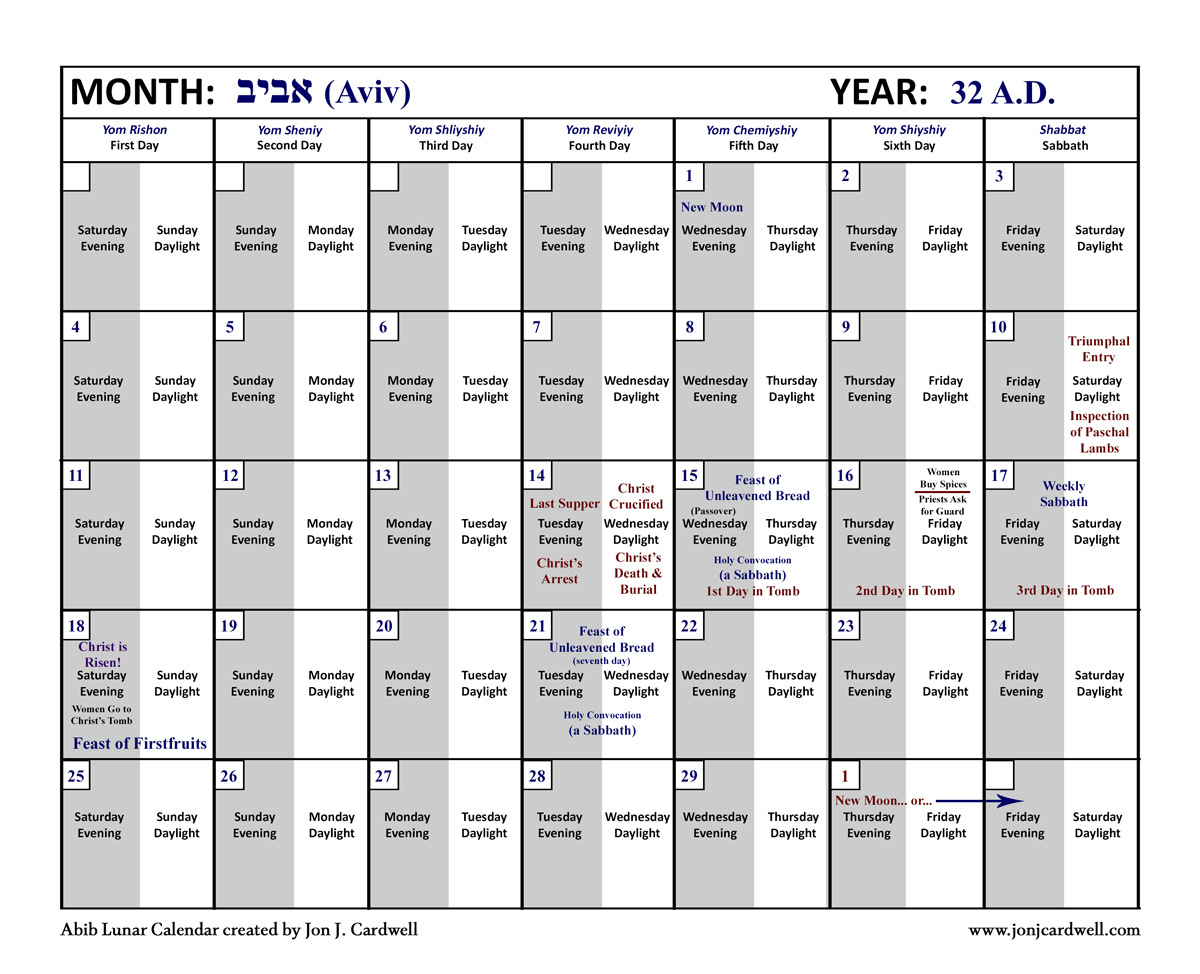
The only way to properly view the days in Christ’s final week is to see them through a Christ-centered, Scripture fulfilled lens. I have reverse-engineered a lunar calendar for the month Abib (or Aviv), aka Nisan on the modern Jewish calendar, it is constructed from Scripture that we certainly know for events surrounding the triumphal entry, crucifixion, and resurrection of the Lord Jesus Christ. The one day we can definitely identify and have any certainty about is the day of Christ’s resurrection. It was the first day of the week following Passover. Matthew’s gospel informs us:
Now after the Sabbath, toward the dawn of the first day of the week, Mary Magdalene and the other Mary went to see the tomb. Matthew 27:1
Matthew indicates that it was still dark when these two women went to the tomb because it was “toward the dawn.” Mark’s gospel gives us a bit more information:
When the Sabbath was past, Mary Magdalene, Mary the mother of James, and Salome bought spices, so that they might go and anoint Him. And very early on the first day of the week, when the sun had risen, they went to the tomb. Mark 16:1-2
Consider the calendar below as it pertains to Christ’s resurrection on the first day of the week.
Of the resurrection of the Lord Jesus, Luke’s gospel informs us of this:
But on the first day of the week, at early dawn, they went to the tomb, taking the spices they had prepared. Luke 24:1
Not only did the women buy spices, but they prepared spices. Like the men who were disciples of Jesus, they were not expecting Jesus to die. When Jesus was arrested on the night he was betrayed, Peter even used a sword to cut off the ear of the high priest’s servant (Matt 26:51; Mark 14:47; Luke 22:50; John 18:10), not understanding that the Lord Jesus must be betrayed, arrested, condemned to death, and suffer and die upon the cross (Matt 16:21-23).
Moreover, John’s gospel account provides additional confirmation:
Now on the first day of the week Mary Magdalene came to the tomb early, while it was still dark, and saw that the stone had been taken away from the tomb. John 20:1
If Jesus was crucified during the daylight hours before the end-of-the-week Sabbath, when did the women buy spices (Mark 16:1)? With the exception of John, and Peter from a distance, the women were the only witnesses among the disciples to His crucifixion. The women were witnesses to where the Lord was buried.[15] The women were also the first to proclaim His resurrection. They could not have bought spices, let alone prepare them for Christ’s burial (Luke 24:1). In those days, there was no instant apothecary mix. They would have had to buy the spices and binding ingredients for the perfume, then crush the spices, cook the spices, and strain the mixture to remove stems and husks. No stores would have been open for them to purchase the ingredients; neither would they have had time to prepare the ingredients unless they worked through the night of the first day of the week. That, however, would have been an impossibility, because they would not have had the necessary spices in the first place.
There are other factors that also refute an end-of-the-week crucifixion, such as the chief priests asking for a guard from Pontius Pilate (which we will examine a bit later). At this point, because of the verses that indicate a middle-of-the-week crucifixion, let’s following a harmonious timeline of the Lord Jesus’ crucifixion and resurrection, noting the supporting Scriptures along the way.
HARMONIOUS TIMELINE OF CHRIST CRUCIFIED AND RISEN
Having reviewed the background for the days of the week, as well as the Sabbaths, especially as they pertain to the Feasts of the LORD, it may be best to present a harmonious overview of the gospels in a timeline form. Let’s begin at the new moon of first month on the Jewish calendar, the month Aviv, also known as Nisan (refer to the lunar calendar above).
Sunset, 1st of Aviv
The new moon was sighted in Jerusalem, and the shofar (ram’s horn) was blown to start Rosh Chodesh, the “head of the month,” as commanded by Scripture (Num 10:10; Psa 81:3-4). For Americans, this would have been known as Wednesday evening; however, dusk would have been the beginning of Yom Chemishiy, the fifth day.
Interestingly, the new moon at the beginning of the month Aviv, the month of the Lord Jesus’ crucifixion and resurrection, falls at the end of the fourth day, correlating to the creation of the sun, moon, stars in the creation account:
14And God said, “Let there be lights in the expanse of the heavens to separate the day from the night. And let them be for signs and for seasons, and for days and years, 15and let them be lights in the expanse of the heavens to give light upon the earth.” And it was so. 16And God made the two great lights—the greater light to rule the day and the lesser light to rule the night—and the stars. 17And God set them in the expanse of the heavens to give light on the earth, 18to rule over the day and over the night, and to separate the light from the darkness. And God saw that it was good. 19And there was evening and there was morning, the fourth day. Genesis 1:14-19
Sunset, 9th of Aviv
Jesus ate supper in Bethany at the home of Mary, Martha, and Lazarus (John 12:1-11). John tells us that this was “Six days before the Passover” (John 12:1). It was the start of the sixth day of the week, Yom Shiyshiy; or what the western solar calendar would identify as Thursday evening. At this supper, Mary anointed the Lord’s feet with expensive perfume and wiped His feet with her hair.
John tells us further,
The next day the large crowd that had come to the feast heard that Jesus was coming to Jerusalem. John 12:12
Sabbath Daylight, 10th of Aviv.[16]
Jesus entered Jerusalem.[17] The Priests were required to inspect the Paschal lambs on the tenth of the month, prior to the Passover:
“Tell all the congregation of Israel that on the tenth day of this month every man shall take a lamb according to their fathers’ houses, a lamb for a household.” Exodus 12:3
Jesus was the ultimate fulfillment of the paschal lamb as the Passover Lamb unto which John the Baptist proclaimed and gave testimony: “Behold, the Lamb of God, who takes away the sin of the world!” (John 1:29).
Jesus rode into Jerusalem upon a donkey, fulfilling Scripture:
Rejoice greatly, O daughter of Zion! Shout aloud, O daughter of Jerusalem! Behold, your King is coming to you; righteous and having salvation is He, humble and mounted on a donkey, on a colt, the foal of a donkey. Zechariah 9:9 (see Matt 21:5; John 12:14-15)
Although Passover and the Feast of Unleavened Bread would not technically begin until the evening of the fifteenth of Aviv, all Jewish males were required to be there on the tenth day of the month so the paschal lambs could be inspected. This also refutes another tradition: Palm Sunday (sorry about that). It was on the Sabbath Day that the Lord Jesus made His triumphal entry, not the first day of the week. This is one of the two reasons the Pharisees told Jesus to rebuke His disciples for waving palm branches and shouting praises to the “King who comes in the name of the Lord” (Luke 19:38-39): because it was a Sabbath Day. Throughout the gospel accounts, the religious leaders, especially the Pharisees, were upset with Jesus for healing on the Sabbath Day, or for His disciples’ plucking grains of wheat as the walked by the field. The other reason they told Jesus to rebuke His disciples was that the people were proclaiming Jesus to be the Messiah.
Sunset, 14th of Aviv
Jesus has a Passover meal with His disciples, three-and-a-half days after the triumphal entry. “It’s not Passover,” someone may object. They’re right; however, there is a little-noticed detail, a loophole if you will, from the instructions of the first Passover that makes this possible, and a fulfillment of Scripture for the Lord Jesus to institute the New Covenant at the last Passover meal with His disciples:
And ye shall keep it up until the fourteenth day of the same month: and the whole assembly of the congregation of Israel shall kill it in the evening. Exodus 12:6, KJV
The English term “in the evening”[18] is the Hebrew phrase בין הערבים (beyn ha-ar-BA-iym), which literally means, “between the evenings.” By observing Passover after sundown, it was still between the evening of the 14th and evening of the 15th of Aviv in their worship of YHVH God.
Moreover, since Jesus is Lord of the Sabbath, He is also Lord of the Passover. He called it a Passover (Luke 22:15), and even though it fell on the day before the Passover, His institution of the New Covenant in communion on a day that was not the Passover allows us to partake of communion more than once per year, thereby allowing Jesus to be the actual and ultimate fulfillment of the Passover by His crucifixion in the middle of the week.
After the Lord Jesus and His disciples departed the room in the upper city and went to the Mount of Olives, Jesus was betrayed by Judas Iscariot and arrested.[19] He was taken first to Annas’ house, where Peter made his first denial of Christ.[20] After the Lord Jesus was questioned and beaten at Annas’ house,[21] He was led away to Caiaphas’ house for a second trial,[22] where Peter, again, follows at a distance and denies the Lord Jesus a second time.[23] False witnesses were brought into Caiaphas’ house to accuse Jesus but could not agree.[24] When questioned by Caiaphas about whether He was the Messiah, the Son of God, Jesus confessed that He was by referencing Daniel 7:13.[25] Caiaphas tore his robes and accused the Lord Jesus of blasphemy and condemned Him as worthy of death.[26] Still in Caiaphas’ house, the Lord Jesus was mocked, abused, and beaten mercilessly.[27] Simon Peter denied the Lord Jesus a third time.[28]
Sunrise, 14th of Aviv
The Lord Jesus was then led to the Sanhedrin at daybreak for His third Jewish trial, where He was officially condemned of blasphemy, and thus to them, worthy of death.[29] This was the fourth day of the week, Yom Reviyiy, what the western lunar calendar would call Wednesday morning. The Lord Jesus was then sent to Pontius Pilate, the governor of Judea.[30] Then, Judas Iscariot hung himself.[31]
The Lord Jesus stood before Pontius Pilate at His first Roman trial. When Pilate found out that Jesus was a Galilean,[32] he sent the Lord to Herod for His second Roman trial, where He was mocked again.[33] The Lord Jesus was then sent back to Pilate, where He stood His third Roman trial.[34] The crowd screamed to free Barabbas.[35] Jesus was beaten and mocked once again; this time, by the Roman guard, who also scourged Jesus under Pilate’s orders.[36] Pilate made one more plea for Christ’s life[37] as Jesus stood so savagely ravaged and bloodied that He was unrecognizable as a human being.[38]
Pilate released Barabbas and Jesus was led out to be crucified.[39] Beginning to carry the patibulum (cross beam portion of His cross), Jesus was so physically weak from the beatings that Simon of Cyrene was pressed into public service to carry the Lord’s cross to Golgotha.[40] A large company of people followed along, weeping, and Jesus spoke to them.[41]
Before nailing Him to the cross, Jesus was offered sour wine mixed with gall, an ancient anesthetic, but Jesus refused it.[42] As they hoisted the crosses of Jesus and two thieves upright to stand tall with the post inserted into the hole drilled in the rock, Jesus prayed for the crowd saying, “Father, forgive them, for they know not what they do.”[43]
Upon the tree of wood, Jesus was crucified between two thieves while the Roman soldiers divided His tunic among themselves and cast lots for His outer garment; the inscription of Jesus’ crime hung above His head upon the cross.[44] Scribes, passers-by, chief priests, soldiers, and even the thieves who hung next to Him, mocked Jesus.[45] One of the thieves repented and asked Jesus to remember him when the Lord entered His kingdom; and Jesus replied, “Truly, I say to you, today you will be with Me in paradise.”[46]
Darkness, 14th of Aviv (noon)
Darkness covered the land for three hours.[47]
Darkness, 14th of Aviv (3:00-4:00 p.m.)
Jesus quoted Psalm 22:1, “My God, My God, why have You forsaken Me?”[48], [49] Jesus then looked at Mary and said, “Woman, behold, your son!” and then looked to John and said, “Behold, your mother!”[50] It was still dark in the land when Jesus cried out, “Father, into Your hands I commit My spirit!”[51] Jesus then said, “I thirst” to fulfill Psalm 69:21.[52] Now that all was fulfilled, having paid the penalty for sin as the only righteous human, Jesus proclaimed, with all the authority as the Son of God, that the debt for sin was paid in full: “It is finished.”[53]
When Jesus gave up the spirit and died, there was a huge earthquake that caused many of the graves to open, and the curtain in the Holy Place was torn in two from top to bottom.[54] Here, Matthew inserted that many dead saints appeared in Jerusalem after the Lord’s resurrection.[55] Centurions standing by gave testimony to Jesus’ righteousness and heavenly heritage, while others repented and went home.[56]
Christ’s death occurred coincident with the evening oblation, the offering of incense in the temple, and the slaughter of the last paschal lamb for Passover supper.
Being the Preparation for the Passover, Pilate commanded that the legs of the crucified be broken so that the condemned would die quickly and be taken down; however, when they came to Jesus, one of the soldiers pierced His side because He was already dead.[57]
Late Afternoon, 14th of Aviv (before sunset)
Joseph of Arimathea asked Pilate for the body of the Lord; so, Nicodemus and some of the women who ministered to Jesus, went with Joseph to a new, nearby garden tomb for the burial of the Lord Jesus.[58]
The day Jesus was crucified was the Preparation for Passover and the Feast of Unleavened Bread, as the Sabbath drew near.[59]
Sunset, Passover, 15th of Aviv
The Feast of Unleavened Bread began. This “holy convocation” was a Sabbath.[60] This was the Lord’s first night in the grave. This was the beginning of the fifth day, Yom Chemiyshiy, or Wednesday evening on the western lunar calendar.[61]
Daylight, 15th of Aviv
The Feast of Unleavened Bread continued, being a Sabbath observance. There were no shops open to buy spices during this holy convocation. This was the end of the fifth day, Yom Chemiyshiy, or Thursday morning and afternoon on the western lunar calendar. This was the Lord’s first day in the grave.
Sunset, 16th of Aviv
The Feast of Unleavened Bread continued; however, as the first day of the feast was over, so had the Sabbath ended. This was not a holy convocation. There were no stores open, however, to buy spices for burial because it was nighttime. This was the beginning of the sixth day, Yom Shiyshiy, or Thursday evening on the western lunar calendar. It was also the Lord’s second night in the grave.
Daylight, 16th of Aviv
The Feast of Unleavened Bread continued, however, it was not a holy convocation. This was the last half of the sixth day, Yom Shiyshiy, or Friday morning on the western lunar calendar. The chief priests and the Pharisees asked Pilate for a guard to seal and secure the tomb:
62The next day, that is, after the day of Preparation, the chief priests and the Pharisees gathered before Pilate. 63and said, “Sir, we remember how that impostor said, while He was still alive, ‘After three days I will rise.’ 64Therefore order the tomb to be made secure until the third day, lest His disciples go and steal Him away and tell the people, ‘He has risen from the dead,’ and the last fraud will be worse than the first.” 65Pilate said to them, “You have a guard of soldiers. Go, make it as secure as you can.” 66So they went and made the tomb secure by sealing the stone and setting a guard. Matthew 27:62-66
We know that they could not have gathered before Pilate on the Sabbath Day (as some might suppose in arguing for a Friday crucifixion). These chief priests and Pharisees were sticklers over the appearance of their own self-righteousness. They opposed Jesus over His healing others on the Sabbath, as mentioned earlier. Moreover, they refused to enter the governor’s headquarters when seeking Christ’s execution, as John informs us in his gospel account:
Then they led Jesus from the house of Caiaphas to the governor’s headquarters. It was early morning. They themselves did not enter the governor’s headquarters, so that they would not be defiled, but could eat the Passover. John 18:28
One of the other difficulties that occurs in understanding the “three days and three nights” of burial is the term “third day,” as used by the chief priests and Pharisees when asking Pilate for a guard to be placed at the tomb, as well as other places in Scripture.[62] The reference to the “third day” addresses disbelief.[63] Again, looking at what the chief priests and Pharisees said:
“Sir, we remember how that impostor said, while He was still alive, ‘After three days I will rise.’ Therefore order the tomb to be made secure until the third day, lest His disciples go and steal Him away and tell the people, ‘He has risen from the dead,’ and the last fraud will be worse than the first.” Matthew 27:63-64
Salome, Mary, and Mary Magdalene went to the market to buy spices for the Lord’s burial and then returned home until the weekly Sabbath was over, according to God’s commandment.[64] This was the Lord’s second day in the grave.
Sunset, 17th of Aviv
The Feast of Unleavened Bread continued. Dusk marked the beginning of the seventh day, Shabbat, for the weekly Sabbath. It is known as Friday evening on the western lunar calendar. This was the Lord Jesus’ third night in the grave.
Daylight, 17th of Aviv
The Feast of Unleavened Bread continued. The weekly Sabbath continued, known as Saturday morning and afternoon on the western lunar calendar. This was the Lord’s third day in the grave.
Sunset, 18th of Aviv
Three days and three nights were complete! Just as Jesus foretold during His earthly ministry (Matt 12:39-40). JESUS, THE SON OF GOD, IS RISEN! Although the huge stone still covered the opening to the tomb, the garden tomb was empty. This was the first day of the week, Yom Rishon, or what is known as Saturday night on the western lunar calendar. The Feast of Firstfruits began.
While it was still dark, the women took their spices to the tomb, there was a huge earthquake, and an angel had taken away the huge stone, not to let Jesus out but to let the disciples see that the tomb was empty.[65]
Daylight, 18th of Aviv
The ladies left the garden tomb to tell the eleven, or rather ten.[66] The Feast of Firstfruits was observed in the Temple.[67] Because the disciples had scattered, it was not easy for the women to find them. Mary Magdalene and some other women found Peter and John and told them the news.[68] Peter and John ran to the tomb, then left after seeing that tomb was empty.[69]
Jesus appeared to Mary Magdalene, who was still weeping outside the tomb’s opening.[70] Mary went to find the disciples to tell them.[71] It may have also been at this time when the Lord appeared to Simon Peter.[72] While some of the other women were still looking for the disciples, Jesus appeared to them on the way.[73]
The Roman guards keeping watch upon the tomb were paid by the chief priests to say that the Lord’s disciples stole His body.[74]
Jesus appeared to Cleopas and another disciple as they walked on the road to Emmaus.[75] Cleopas and the other disciple returned to Jerusalem to tell the disciples.[76] Jesus appeared to them, but of the eleven, Thomas was missing.[77]
26th of Aviv
Jesus appeared again to the disciples while Thomas was with them.[78] This would have been the second day of the week, Yom Sheniy, because it was “eight days later” (John 20:26). It is known as either Sunday evening or Monday morning or afternoon on the western solar calendar.
CONCLUSION
Although I mentioned this in Part Two of this series, it is worth mentioning again. Does this mean that those who believe in a Friday crucifixion are not saved? God forbid. The resurrection is an essential truth of Christ’s gospel; but how long Christ was buried is not essential for salvation. The thief on the cross did not know how long the Lord Jesus would be in the tomb, yet he was saved. How essential, though, is believe in Christ’s resurrection? Here’s Paul’s argument for its essential truth:
But if there is no resurrection of the dead, then not even Christ has been raised. And if Christ has not been raised, then our preaching is in vain and your faith is in vain. 1 Corinthains 15:13-14
My argument against the tradition of a Friday crucifixion still stands, however. If we purport to stand upon the Scriptures of the Old and New Testaments as our divine standard yet shrug off the Lord’s very words from Matthew 12:39-40 as being unimportant, inconsequential, or a mysterious parable without prayerfully considering how He may be exalted by a deeper understanding of His Word, then we are exhibiting a poor, sloppy, and even carelessly wicked testimony to a dying world. We cannot adamantly or effectively defend a literal “six-day creation” while waffling on a literal three-day-and-night burial of Christ and expect to be taken seriously by the reprobate unbeliever. I have encountered several unbelievers who recognize this inconsistency.
The resurrection of Christ is a greatest testimony of God’s glory because it validates the gospel justice, goodness, and holiness of Christ’s crucifixion. Paul goes on to say,
15We are even found to be misrepresenting God, because we testified about God that He raised Christ, whom He did not raise if it is true that the dead are not raised. 16For if the dead are not raised, not even Christ has been raised. 17And if Christ has not been raised, your faith is futile and you are still in your sins. 18Then those also who have fallen asleep in Christ have perished. 19If in Christ we have hope in this life only, we are of all people most to be pitied. 20But in fact Christ has been raised from the dead, the firstfruits of those who have fallen asleep. 21For as by a man came death, by a man has come also the resurrection of the dead. 22For as in Adam all die, so also in Christ shall all be made alive. 1 Corinthians 15:15-22
Hallelujah! What a Savior!

FOOTNOTES:
[1] The Kindle eBook is available free at this url, https://www.amazon.com/dp/B00O75K70M. The eBook is also available free of charge at Amazon.co.uk, Amazon.au, Apple Books, Barnes & Noble, Everand, Fable, Kobo, Smashwords, Thalia, and Vivlio.
[2] Exodus 12:15
[3] Genesis 1:31
[4] I include Luke with the Jewish writers. Although he has been considered a Gentile by some preachers I have heard over the years, perhaps because he has a Greek name (Col 4:10; Philem 1:24; 2 Tim 4:11), this alone is insufficient to call him a Gentile. The first deacons ordained in Christ’s church were Jews with Greek names (Acts 6:5). While my Greek skills are not as strong as my Hebrew, Luke’s Greek in the Gospel account and the Acts of the Apostles contains many Hebrew expressions, some of them being used more than any other gospel account, such as καὶ ἐγένετο, the equivalent of the Hebrew וַיְהִי (vay-HIY), which means “And it came to pass” or “And it was,” which means very little to the Greek thinker. To the Hebrew thinker, it not only refers to a passage of time, but it signifies either a prophetic event is about to happen, or God has already fulfilled His work, as it is written, ויהי־ערב ויהי־בקר יום אחד (vay-HIY_E-rev vay-HIY_bō-QER yōm ech-AD). “And it came to pass evening, and it came to pass morning, Day One.”
[5] Twilight literally means “two lights.” While the sun is on the horizon as it sets, it provides light. As it pertains to the Passover, since it is in the middle of the month, as the sun is setting, the full moon is becoming visible. Thus, in the middle of the month, at dusk you have two lights. The word in Hebrew from which “twilight” has been translated is עֶרֶב (E-rev), which means “dusk” or “evening.” (cf. Ex 12:6; see paragraph associated with Footnote #17).
[6] Abib is the biblical name for the beginning of months (Ex 12:2; 13:4). The modern Jewish name for the month is Nisan, which occurs in the March-April timeframe of a solar calendar.
[7] Torah Mishna, Beitzah 5:2; see Mishna Torah commentary on the right column of the webpage by going to: https://www.sefaria.org/Leviticus.23.7?lang=bi&with=Mishneh%20Torah,%20Rest%20on%20a%20Holiday&lang2=en
[8] “A person may be [punished by] lashes for performing on a holiday any labor for which he is liable on the Sabbath, if it is not necessary for the preparation of food, with the exception of the transfer of articles from one domain to another and the kindling of a fire.” Torah Mishna, Beitzah 5:2; see weblink in footnote #6.
[9] Interestingly, the KJV is a better translation of Exodus 12:6 from the original Hebrew, which states: And ye shall keep it up until the fourteenth day of the same month: and the whole assembly of the congregation of Israel shall kill it in the evening. While the ESV captures the first part literally, “shall keep it” being singular, where the ESV translates the latter portion as “shall kill their lambs…”, the KJV states that the whole assembly of the congregation shall “kill it,” singular. The word for “it” can also be translated “him.” It is the same word for both. My translation of the original Hebrew from a Christ-centered interpretation would be: “And you shall keep Him until the fourteenth day of this month; and the whole assembly of the congregation shall kill Him between the evenings.” This translation will be important later.
[10] Also, because of the lunisolar, calculated calendar, many modern Jews observe the Feast of Weeks for two days, the second day to account for diaspora Jews living throughout the world. If it occurs coincident with a weekly Sabbath, then it is sometimes stretched into a three-day observance by some rabbinical Jews.
[11] The topic of the Christian sacrifice is worthy of its own series of articles, but we will restrain ourselves here.
[12] The question then arises, “Why is a seven-day feast observed for eight days?” I believe there is an excellent Christ-centered explanation for this, however, the details behind it would take too much time to explain it here in this series of articles. Perhaps we can revisit the feasts in a separate series of articles to expound upon Christ fulfilling each one.
[13] The Open Brethren was formed in 1847 by several members of the Plymouth Brethren, including George Müller, the Open Brethren believing in autonomy of the local church assembly while the Plymouth Brethren wanted submission to a centralized authority. One of the primary reasons for Müller leaving was because of the Plymouth Brethren’s dogmatic insistence upon belief in dispensational theology and eschatology.
[14] I don’t disagree with the year being 32 AD. We have seen this as being the most likely timeframe from the evidence of Scripture. I had used The Coming Prince as a reference in the past; however, as I’ve prayerfully considered it, I realized that Sir Robert Anderson’s conjecture severely misses the mark.
[15] Matt 27:61; Mark 15:47; Luke 23:55
[16] Sunset marks the beginning of the day for the Jew. Since dinner was usually eaten after sunset (and still is among Jews today), the meal that Jesus had at Lazarus’ house would be considered our Thursday evening; therefore, Friday morning was still the same day and “the next day” of John 12:12 began on Friday evening and ended Saturday evening.
[17] Matthew 21:1-11; Mark 11:1-10; Luke 19:28-40; John 12:12-19
[18] See also Footnotes #5 & #9
[19] Matt 26:55-56; Mark 14:48-53; Luke 22:52-53; John 18:12
[20] Luke 22:54-57; John 18:13-18
[21] John 18:19-23
[22] Matt 26:57; Mark 14:53; John 18:19
[23] Matt 26:58; Mark 14:54; Luke 22:58; John 18:25
[24] Matt 26:59-62; Mark 14:55-60
[25] Matt 26:63-64; Mark 14:61-62
[26] Matt 26:65-66; Mark 14:63-64
[27] Matt 26:67-68; Mark 14:65; Luke 22:63-65
[28] Luke 22:59-62; John 18:26-27
[29] Matt 27:1; Mark 15:1; Luke 22:66-71
[30] Matt 27:2; Mark 15:1; John 18:28
[31] Matt 27:3-10
[32] Matt 27:11-14; Mark 15:1-5; Luke 23:1-6; John 18:28-32
[33] Luke 23:7-11
[34] Luke 23:11-16; John 18:33-38
[35] Matt 27:15-23; Luke 23:17-23; John 18:39-40
[36] Matt 27:24-30; Mark 15:15-19; Luke 23:24; John 19:1-3
[37] John 19:4-15
[38] Isa 52:14
[39] Matt 27:31; Mark 15:20; Luke 23:25; John 19:16
[40] Matt 27:32-33; Mark 15:21-22; Luke 23:26; John 19:16-17
[41] Luke 23:27-31
[42] Matt 27:34; Mark 15:23
[43] Luke 23:32-34
[44] Matt 27:35-38; Mark 15:24-28; Luke 23:34-38; John 19:18-24
[45] Matt 27:39-44; Mark 15:29-32
[46] Luke 23:39-43
[47] Matt 27:45; Mark 15:33; Luke 23:44
[48] Matt 27:46-49; Mark 15:34-36
[49] This statement not only pointed to the prophetic picture of the cross hundreds of years before crucifixion was invented, it also lets us know: “For our sake He made Him to be sin who knew no sin, so that in Him we might become the righteousness of God” (2 Cor 5:21); and, “Christ redeemed us from the curse of the law by becoming a curse for us—for it is written, “Cursed is everyone who is hanged on a tree” (Gal 3:13); for Jesus Christ was bruised, crushed under the holy, just, and righteous wrath of God: “Surely He has borne our griefs and carried our sorrows; yet we esteemed Him stricken, smitten by God, and afflicted. But He was pierced for our transgressions; He was crushed for our iniquities; upon Him was the chastisement that brought us peace, and with His wounds we are healed…. Yet it was the will of the LORD to crush Him; He has put Him to grief; when His soul makes an offering for guilt, He shall see His offspring; He shall prolong His days; the will of the LORD shall prosper in His hand” (Isaiah 53:4-5, 10). Keep in mind that it wasn’t the beatings Jesus endured that saved us, but when He suffered the wrath of God for sins He did not commit, He did so upon that cross when He was at His weakest point physically.
[50] John 19:25-27
[51] Luke 23:46. Adam failed when he did not commit his spirit to his heavenly Father; and as a result, sin entered the human race. Jesus did exactly what Adam did not do: Jesus humbled Himself, committing His spirit unto God’s will and becoming obedient unto death (see Phil 2:8).
[52] John 19:28-30
[53] John 19:30
[54] Matt 27:50-53; Mark 15:37-38; Luke 23:46; John 19:30
[55] Matt 27:52-53
[56] Matt 27:54; Mark 15:39; Luke 23:47
[57] John 19:31-38
[58] Matt 27:55-61; Mark 15:40-47; Luke 23:49-53; John 19:38-42
[59] Luke 23:54
[60] Lev 23:6-7
[61] Because Joseph and Nicodemus had handled the dead body of our Lord (or at least their servants had), and being at the tomb they were ceremonially defiled. They could not observe Passover, but must wait a month for the second Passover, called Pesach Sheniy (Num 9:1-14).
[62] Hos 6:2; Matt 16:21; 17:23; 20:19; Luke 9:22; 18:33; 24:7, 21, 46; Acts 10:40; 1 Cor 15:4; et al
[63] The Holy Spirit rather winks at us through the Scriptures by using this “third day” term as an off-handed reference pointing to the fact that the religious leaders did not believe that Jesus was the Messiah. This is why the reference is used by Cleopas and his companion on the road to Emmaus (Luke 24:21); they were “slow of heart to believe” (Luke 24:25). The chief priests represent an evil and adulterous generation seeking after signs (Matt 12:39-40), but they should have been seeking the Messiah. Nevertheless, our gracious Lord, King, and God gave them the only sign, three days and nights in the tomb, then He rose from the dead (Matt 12:39-40).
[64] Mark 16:1; Luke 23:55-56
[65] Matt 28:1-7; Mark 16:2-7; Luke 24:1-8; John 20:1
[66] Matt 28:8; Luke 24:9. Judas was dead and Thomas was not with them at that time (John 20:24).
[67] Lev 23:10-11; 1 Cor 15:20
[68] Luke 24:10-11; John 20:2
[69] Luke 24:12; John 20:3-10
[70] John 20:11-17
[71] John 20:18
[72] 1 Cor 15:5
[73] Matt 28:9-10
[74] Matt 28:11-15
[75] Luke 24:13-32
[76] Luke 24:33
[77] Luke 24:34-48; John 20:19-24. Sometimes “evening” is an expression that means afternoon, e.g., 3:00 p.m. is the time of the “evening sacrifice” or “evening oblation.”
[78] John 20:24-31