

Online Bible Audio/Readings Links (ESV)
2/14 Reading Portions: Genesis 47; Luke 1:1-38; Job 13; 1 Corinthians 1
Matthew 12:38-40
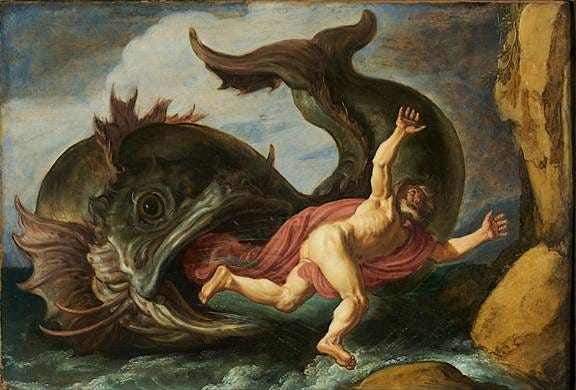
Then some of the scribes and Pharisees answered Him, saying, “Teacher, we wish to see a sign from You.” But He answered them, “An evil and adulterous generation seeks for a sign, but no sign will be given to it except the sign of the prophet Jonah. For just as Jonah was three days and three nights in the belly of the great fish, so will the Son of Man be three days and three nights in the heart of the earth.”
Jonah 1:17
“And the LORD appointed a great fish to swallow up Jonah. And Jonah was in the belly of the fish three days and three nights.”
RESURRECTION
Jesus said that this event was the only sign the world would receive that He was, is, and evermore shall be, whom He claimed to be, and that He came to do what He said He would. The Lord Jesus spoke of His resurrection from the dead.
Quite often, pastors, teachers, theologians and Bible expositors will try to justify the event of Jonah’s three days and nights in the great fish’s belly with the church’s equivalent of an “urban legend.” You may have heard the story of James Bartley, which suggests that a 19th century crewmember onboard the whaling ship, the Star of the East, was swallowed by a whale and survived. Edward B. Davis, professor at Messiah College in Grantham, Pennsylvania, published his extensive research on the Bartley episode in a 1991 issue of The American Scientific Affiliation. Davis states that no such event ever took place.[i]
We’re missing the point when trying to rationalize the story of Jonah through natural explanations. Jonah’s episode in the fish’s belly was a supernatural event because it was a prophetic foreshadow of another supernatural event, the main event: the death, burial, and resurrection of Jesus Christ.
I had written this article, originally in 2002 and posted it on the Internet a few times as an independent article. A comment to the blog article stated that I had missed the point of Christ’s statement. He told me that the passage in Matthew 16:4 meant that there would be no sign at all to an evil and adulterous generation. I replied (and I pray that it was humbly and respectfully) that the sign of Jonah was the empty tomb and the resurrection itself, citing Matthew 12:39-40, because it was consistent with what the Lord had spoken to the religious objectors at the beginning of His ministry when He turned over the money changers, recorded in John 2:16-22,
And He told those who sold the pigeons, “Take these things away; do not make My Father’s house a house of trade.” His disciples remembered that it was written, “Zeal for Your house will consume Me.” So the Jews said to Him, “What sign do You show us for doing these things?” Jesus answered them, “Destroy this temple, and in three days I will raise it up.” The Jews then said, “It has taken forty-six years to build this temple, and will You raise it up in three days?” But He was speaking about the temple of His body. When therefore he was raised from the dead, His disciples remembered that He had said this, and they believed the Scripture and the word that Jesus had spoken.[ii]
3 Days and 3 Nights
Nowhere in Scripture does it specify that Friday was the day the Lord was crucified. I believe these conjectures come from a misunderstanding of both the Jewish Sabbaths and the Hebrew Scriptures. The fact of the matter is that Jesus could not have been crucified on any other day than Wednesday. I’ve made this statement based upon Scripture. Consider this passage from the Gospel of Mark:
When the Sabbath was past, Mary Magdalene, Mary the mother of James, and Salome bought spices, so that they might go and anoint Him. And very early on the first day of the week, when the sun had risen, they went to the tomb. Mark 16:1-2
The passage above tells us that the sabbath had come and gone. The question is: to which sabbath was Mark referring?
We must keep in mind that a day on the Hebrew calendar begins at sunset and ends at the following sunset, as it is written,
God called the light Day, and the darkness He called Night. And there was evening and there was morning, the first day. Genesis 1:5
Evening first, and then morning reckons a twenty-four hour day. For example, the weekly sabbath for the Jews begins at sunset on Friday and ends at sunset on Saturday.
And Jesus also tells us that a day is twelve hours long, while implying that a night would also be twelve hours long:
Jesus answered, “Are there not twelve hours in the day? If anyone walks in the day, he does not stumble, because he sees the light of this world. But if anyone walks in the night, he stumbles, because the light is not in him.” John 11:9-10
It is surely no coincidence that the Lord Jesus makes this statement just prior to raising Lazarus from the dead and proclaiming that He—Jesus—is “the Resurrection and the Life” (John 11:25).
We also know from the passage that the women went to the tomb where Jesus was buried at sunrise on Sunday, the first day of the week. In fact, all four gospel accounts agree on that point (see Matt 28:1; Luke 24:1; John 20:1). In fact, in the Gospel of John even tells us that it was still dark. Understanding this, the question again arises: to which sabbath was Mark referring?
Sabbath (Hebrew שַׁבָּת, shab-BAWT) means “rest,” “cease,” “repose,” or “intermission.” Sabbath also refers to the seventh day of the week as a day of rest unto the LORD (see also Gen 2:2; Exo 20:8; Lev 23:3, 11, 16; et al). Sabbath also refers to a specific day of rest during the LORD’s Feasts, regardless of the day of the week it falls upon, i.e., the day before the Day of Atonement (Lev 23:32). Sabbath also refers to a year of rest for the land (Lev 25:2-4). Finally, sabbath also refers to a sabbath of sabbath years, called “Jubile” (Lev 25:8-10).
There is another Hebrew term that is translated “sabbath of rest” in my Hebrew Bible. It is the term שַׁבָּת שַׁבָּתוֹן (shab-BAWT shab-baw-TŌN) It is found in Exodus 31:15 concerning the weekly Sabbath, but is also found in Leviticus 16:31 as it pertains to the Day of Atonment, Yom Kippur, as well as in Leviticus 23:3 with regard to the weekly Sabbath and all seven of the Feasts of the LORD. When Shabbaton is used in the sentence by itself, it has the same meaning as Shabbat, or Sabbath, and it is used in two passages in particular: at the Feast of Trumpets (Lev 23:24) and the first and eighth days of the Feast of Tabernacles (Lev 23:39).
With regard to the Passover, there were two Sabbaths, or holy convocations whereas no ordinary work could be done; on the first day of the feast and on the seventh day of the feast (Lev 23:7-8).
Mark could only be speaking of the Sabbath that coincides with the first day of the Feast of Unleavened Bread when he wrote that the women bought spices to anoint Jesus’ body after the Sabbath had passed (Mark 16:1). Mark even makes reference to the day before Shabbaton (Greek προσαββατον, prosabbaton) a few verses earlier:
And when evening had come, since it was the day of Preparation, that is, the day before the Sabbath, Mark 15:42 (emphasis added)
Matthew and Luke make use of the exact same Greek word, sabbaton when referring to the days following the Lord’s crucifixion (Matt 28:1; Luke 23:54, 56). Possibly because of Matthew’s use of the word, many Bible students have seen the Unleavened Bread “Sabbath” as coinciding with the weekly sabbath:
Now after the Sabbath, toward the dawn of the first day of the week, Mary Magdalene and the other Mary went to see the tomb. Matthew 28:1
But as we have seen earlier, the Hebrew Shabbat and Shabbaton sometimes carry the same meaning (and in some rabbinical commentaries, are sometimes interchangeable). Luke, however, presents two sabbaths, consistent with Mark’s account:
It was the day of Preparation, and the Sabbath was beginning. The women who had come with Him from Galilee followed and saw the tomb and how His body was laid. Then they returned and prepared spices and ointments. On the Sabbath they rested according to the commandment. Luke 23:54-56
Even if that would seem a little murky, a little unclear, or a little confusing, we can consider that God commanded that Israel observe His Feasts as “holy convocations” (Lev 23:4). There were three specific times in a year that every Torah observant male Jew was to appear before YHVH God, the Feast of Unleavened Bread, the Feast of Weeks, and the Feast of Tabernacles (Ex 23:14-17; Deut 16:16). God called certain days of all three of these feasts “holy convocations” (Lev 23:7-8, 21, 35-36). God also commanded the Jews that they were not allowed to do any work as part of the holy convocation, the same commandment He gave in observing the weekly sabbath (Lev 23:3). A holy convocation and the sabbath were interchangeable to the Jewish mind as being days when no one was allowed to work. John calls them high holy days in his gospel account:
Since it was the day of Preparation, and so that the bodies would not remain on the cross on the Sabbath (for that Sabbath was a high day), the Jews asked Pilate that their legs might be broken and that they might be taken away. John 19:31
Moreover, when the women arrived at the tomb, it was still dark, as the Gospel of John records:
Now on the first day of the week Mary Magdalene came to the tomb early, while it was still dark, and saw that the stone had been taken away from the tomb. John 20:1
There was no way they bought spices if Jesus was crucified on Friday.
So, let’s work backwards…
We know that Jesus died at some time after 3:00 in the afternoon (Matt 27:46; Mark 15:34; Luke 23:44). If Jesus died on Friday, then from before sundown Friday to Sunday morning there would not be any markets open for the women to buy the spices. Even if… IF the women already had the spices, as some might suggest, attempting to reconcile Mark 15:42-16:2 and Luke 23:54-56 with a Friday crucifixion, Luke specifically tells us that the women “prepared spices and ointments” (Luke 23:56). If they observed God’s commandments, they wouldn’t have “prepared” anything because the Law commands that they could not work, anywhere at all, on the Sabbath (Lev 23:3). So, there is no way that Jesus could have been crucified on Friday.
If Jesus was crucified on Thursday afternoon, that sundown would have been the beginning of the Feast of Unleavened Bread and considered a holy convocation (sabbaton). Therefore, no markets would be open for buying the spices; and since it was a Shabbaton, they couldn’t even prepare the spices that day. The same circumstances for Friday would have existed, thus back-to-back Sabbaths. So, there is no way that Jesus could have been crucified on Thursday.
That leaves Wednesday. Wednesday would have allowed the women to observe of a holy convocation for the Feast of Unleavened Bread on Thursday, the opportunity to purchase and prepare the spices and ointments on Friday, to observe the weekly sabbath from sundown Friday to sundown Saturday, and to make a pre-dawn visit to the Garden Tomb early Sunday morning. The Lord Jesus Himself taught,
“Do not think that I have come to abolish the Law or the Prophets; I have not come to abolish them but to fulfill them. For truly, I say to you, until heaven and earth pass away, not an iota, not a dot, will pass from the Law until all is accomplished.” Matthew 5:17-18
It seems unlikely that God would give His commandments in the Law of Moses (Genesis to Deuteronomy) and then allow events to unfold that result in the Law being violated by Jesus’ disciples before all prophecies about the Messiah could be fulfilled. Remember, under the inspiration of the Holy Spirit, Luke tells us that the Lord’s disciples kept the Sabbath commandment; or at least, the women did:
Then they returned and prepared spices and ointments. On the Sabbath they rested according to the commandment. Luke 23:56
Counting It Out
Jesus was crucified on Wednesday, the middle of the week. He was placed in Joseph of Arimathea’s tomb just before sundown, so His buried body was in the tomb on Wednesday night and Thursday daytime (first night and day), being a Sabbath to the Lord, the Feast of Passover and the first day of the Feast of Unleavened Bread.
Thursday night and Friday daytime, the stores would have been open (second night and day). Remember, the disciples, and the women accompanying Jesus, were not expecting their Messiah to be crucified. They didn’t have spices on hand for burial. They bought spices because the stores would have been open for them to do so.
Friday night begins the weekly Sabbath and ends at sundown on Saturday night (third night and day), literally fulfilling the Lord Jesus’ prophecy and sign of Jonah. He rises powerfully and wonderfully on Saturday night.
Before the sun was up, while it was still dark, the women brought their purchased and prepared spices to the garden tomb, and the 2-ton stone was lifted out of its track, not to let Jesus out, but to let His disciples in. Hallelujah! What a Savior!
Spiritual Significance or Splitting Hairs
Some may say, “Okay, Cardwell, that’s pretty compelling stuff; but is it really that important?” I believe that it is important (otherwise I wouldn’t have written it). I believe that it also has immeasurable value to our growth as Christian believers. How so?
Let’s look again at what Jesus said:
“An evil and adulterous generation seeks for a sign, but no sign will be given to it except the sign of the prophet Jonah. For just as Jonah was three days and three nights in the belly of the great fish, so will the Son of Man be three days and three nights in the heart of the earth.” Matthew 12:39-40
Many evangelicals that propose, support, or advocate a Friday crucifixion, often explain that a partial day in the Hebrew mind is counted as a full day. That’s true in some contexts; however, the chief problem with that rationalization is that Jesus presented that the timeframe for this sign would be “three days and three nights.” Even if only the first day and the last night were partial, you still have a problem with the two days and nights in between.
Furthermore, this was the only sign that Jesus said that He would give these unbelieving Pharisees. With as many signs and wonders that He performed during His earthly ministry, does it seem likely, or even reasonable, that Jesus would give them an ambiguous reference? I don’t think so.
The Resurrection of Jesus Christ is the most important and most prominent sign to the world that God gave His only begotten Son as the atoning Sacrifice for a sinful world. Jesus predicted it before His death so that there would be no mistake that He was who He said He was: God in human flesh. Even after His crucifixion, the unbelieving rulers of Israel asked Pilate for a placement of guards at the tomb because they remembered what He said about the sign of Jonah:
The next day, that is, after the day of Preparation, the chief priests and the Pharisees gathered before Pilate and said, “Sir, we remember how that impostor said, while He was still alive, ‘After three days I will rise.’ Therefore order the tomb to be made secure until the third day, lest His disciples go and steal Him away and tell the people, ‘He has risen from the dead,’ and the last fraud will be worse than the first.” Pilate said to them, “You have a guard of soldiers. Go, make it as secure as you can.” So they went and made the tomb secure by sealing the stone and setting a guard. Matthew 27:62-66
Now, Matthew’s account presents the mention of “the third day.” Knowing what we know about the Sabbaths, and how the three days and nights in the tomb are literal days and nights, how then is “the third day” reconciled. The third day was reference toward the hardened hearts of those who opposed the gospel of Christ. They sought a guard for Friday, Saturday, and Sunday. The guard only lasted two days (Matt 28:11-15).
If we start quibbling and compromising on Jesus’ own words about the only sign He gave the world, then we might compromise in other areas. Soon, we might begin to think that God didn’t really create the heavens and the earth in six literal days. Then we may start making concessions for other Scripture, suggesting that God didn’t really mean for me to forgive that person; or that little thing couldn’t possibly be a sin; or God couldn’t actually want me to do that…. And because the sign of Jonah was a prophecy concerning Jesus’ first coming, faltering here will cause us to flounder with regard to His future coming. If I treat His past promises with indifference, why would anyone believe that I am passionate about His promises to come?
Yes, a look at the sign of Jonah is more than splitting hairs with a theological topic; it’s realizing that God is resolute about the details of His holy word, and therefore, He is as interested in the details of the lives of all those who are made alive because of trusting in the death and resurrection of Jesus Messiah. Let us therefore,
Kiss the Son, lest he be angry, Psalm 2:12
Hallelujah! What a Savior!
[i] https://www.asa3.org/ASA/PSCF/1991/PSCF12-91Davis.html
[ii] As this was the beginning of the Lord’s earthly ministry, Jesus may have turned over the moneychangers’ tables several times in the temple throughout His three-and-a-half-year ministry.
[iii] Pieter Lastman (1583-1633), “Jonah and the Whale” (1621). This image is in the public domain in the United States, and in those countries with a copyright term of life of the author plus 100 years or less. The image is used courtesy of http://commons.wikimedia.org/wiki/File:Pieter_Lastman_-_Jonah_and_the_Whale_-_Google_Art_Project.jpg (Wikimedia.org)
